By Khem “Babu” Khadaka, founder, driving these roads since 1996 · Last updated: 2027 season (October 2026 – June 2027)
Tipping drivers is the question our guests ask most often, and they usually ask it on the last evening of the trip, quietly, from the back seat.
Nobody wants to insult the man who drove them safely for a week. Nobody wants to overdo it either. And advice online on tipping drivers swings from “₹50 is plenty” to “20% of the tour price”.
We run a family car-and-driver business in India and Nepal, and our drivers, guides and porters are people we know by name. This guide gives the amounts that are fair in 2026–27, in rupees and dollars, and the reasoning behind them.
So instead of asking only “How much should I tip?”, it helps to ask a better question:
What amount is fair for the work done, in the local context, and how do I hand it over without any awkwardness?
That’s what this guide is built around. It covers tipping drivers in India and Nepal by the day and by the trip, how much to tip guides at monuments, the right tip for a trekking guide and porter in Nepal, hotels and restaurants (including India’s rules on service charge), the small tips nobody warns you about, which currency to use and how to hand the money over without awkwardness.
In most of Europe a tip is small change. In the United States it’s part of the wage. India and Nepal sit somewhere in between, and that’s where the confusion starts.
Here, a tip is a thank-you for good service, not a hidden part of the price. A professional driver earns a salary or day rate, plus an allowance when he’s away from home. The tip matters to him, but it isn’t his wage.
Travellers also compare notes across very different jobs. A ₹100 tip for an airport taxi and ₹4,000 for a driver who spent ten days with a family are both correct. Tipping drivers depends on the days and the work, not on a fixed percentage.
Our own rule is simple. Tipping is always optional. Our prices already cover the driver’s pay, his food and his lodging, so you owe him nothing beyond good manners. If you’re happy, a tip is welcome. If something went wrong, tell us, because that matters more to us than the tip.
The fairest way to think about tipping drivers in India is per day of service, then add it up at the end. These are the ranges we give our own guests for the 2026–27 season:
| Group and vehicle | Fair tip per day | Generous tip per day | Roughly in USD |
|---|---|---|---|
| 1–3 travellers, sedan | ₹300–500 | ₹600 | USD 3–6 |
| 4–5 travellers, SUV | ₹400–600 | ₹800 | USD 4–8 |
| 6–8 travellers, Tempo Traveller | ₹500–800 | ₹1,000 | USD 5–10 |
| Half-day city tour or short transfer day | ₹200–300 | ₹500 | USD 2–5 |
Indian travel companies and guidebooks quote very similar figures, typically ₹300–600 a day for one or two passengers and ₹500–800 for three to five. Our table sits in the same band, adjusted for vehicle size.
The dollar figures use a rate of about ₹95 to the US dollar, which is where the rupee traded in September 2026. Check the rate before you travel, and think in rupees rather than dollars. It keeps the amount in proportion to local wages.
Why more for bigger groups? A Tempo Traveller is harder to drive and park, there’s far more luggage to lift, and the tip is shared across more people, so each person still pays very little.
Per-day figures are easy to agree with and hard to add up at the end of a holiday. Here’s what they come to on our most popular routes, for the whole group, not per person:
| Trip | Group and vehicle | Fair total tip | Generous total tip |
|---|---|---|---|
| Same-day Taj Mahal tour from Delhi | 2 people, sedan | ₹400–500 | ₹700 |
| Golden Triangle, 4 days | 2 people, sedan | ₹1,200–2,000 | ₹2,500 |
| Golden Triangle, 6 days | 4 people, SUV | ₹2,400–3,600 | ₹4,800 |
| Shimla and Manali, 8 days | 2 people, sedan | ₹2,400–4,000 | ₹4,800 |
| Rajasthan Grand Circuit, 12 days | 6 people, Tempo Traveller | ₹6,000–9,600 | ₹12,000 |
Seen as a share of the trip, that’s small. On our 4-day Golden Triangle by sedan (USD 356 for the whole car), a ₹2,000 tip is about USD 21, or 6% of the price. That’s generous by local standards without being extravagant.
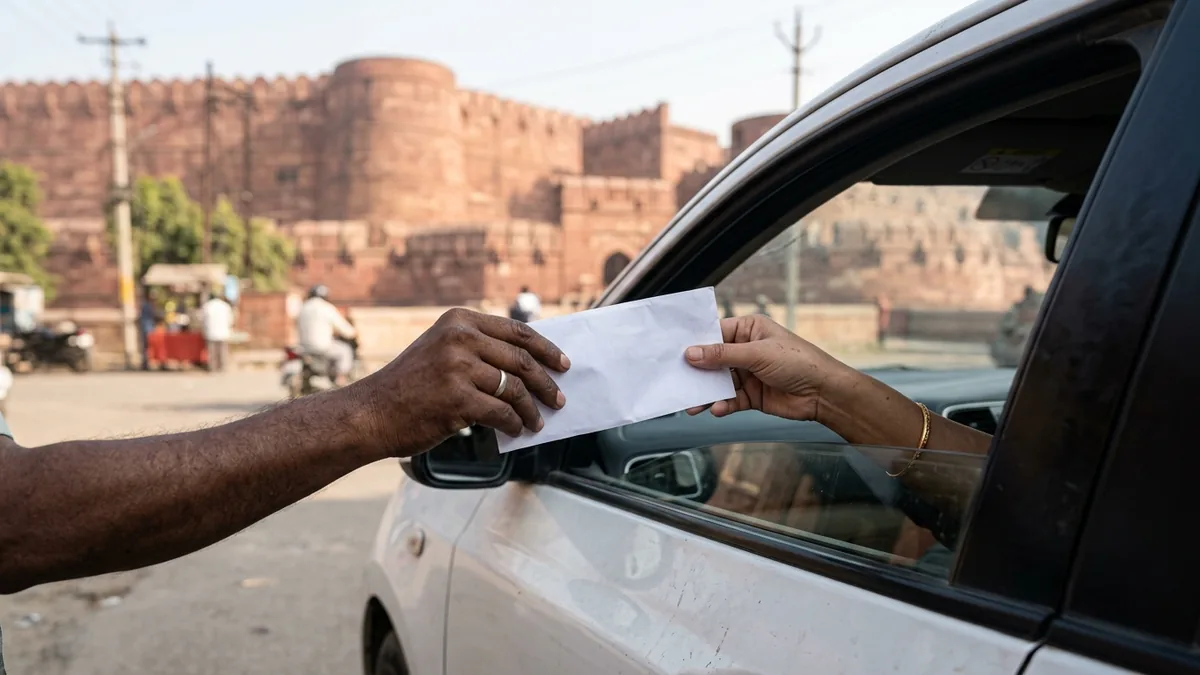
If you want one rule of thumb for tipping drivers on a multi-day tour, it’s this: one day’s tip for every day on the road, rounded up to a clean number, in one envelope at the end.
The per-day ranges are a starting point. These are the things that reasonably move you towards the top or the bottom of them.
If any of those happen on one of our trips, please call us that day. We would rather fix it while you’re still travelling. And traffic should never reduce the tip: nobody controls the Delhi ring road on a Monday morning.
Not every driver is with you for a week. Tipping drivers on shorter jobs means smaller amounts, and some jobs need no tip at all.
| Situation | Usual tip | Notes |
|---|---|---|
| Private driver for one full day | ₹300–500 | Same logic as a multi-day tour |
| Pre-booked airport pick-up or drop | ₹100–200 | More if he waited through a long flight delay |
| Metered or app taxi (Uber, Ola) | Round up | Tip in the app if it offers the option; not expected |
| Auto-rickshaw with an agreed fare | None | Pay the agreed fare; round up for extra help |
| Cycle-rickshaw in old Delhi or Agra | ₹20–50 | Hard physical work; a small extra is appreciated |
Our same-day Delhi to Agra trip by car is a good example of a long single day: 12 to 14 hours door to door. Treat that as one full day and a little more.
The how matters almost as much as the how much. Done well, the moment is warm. Done badly, it can feel like a transaction or, worse, like the start of a negotiation.
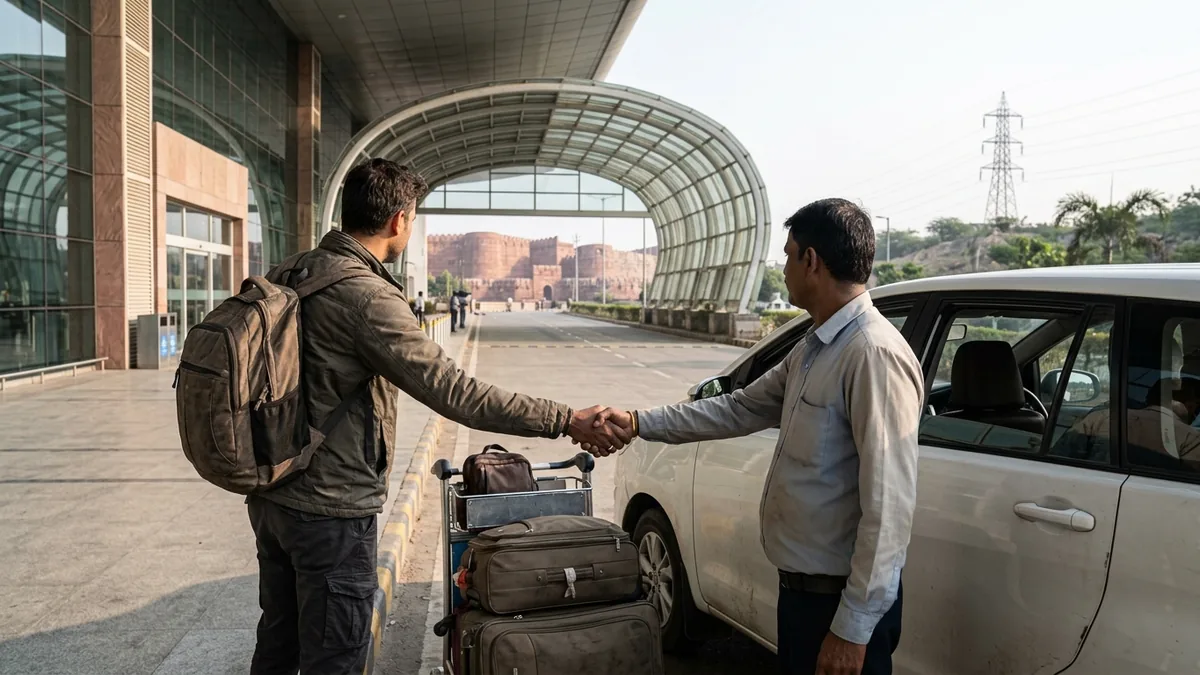
If a driver asks for more after you’ve given the envelope, you can smile, say thank you and leave it there. It happens occasionally, and it’s rarely personal. If it happens on one of our trips, we want to know.
Guides work differently from drivers. They’re usually with you for a few hours at one site, and they’re paid a fixed fee for the tour. The tip sits on top of that fee.
| Who | Usual tip | Notes |
|---|---|---|
| Licensed monument guide, half day (Taj Mahal, Amber Fort) | ₹200–400 | For the group, on top of the guide fee |
| Licensed city guide, full day (Delhi, Jaipur, Varanasi) | ₹500–700 | Up to ₹1,000 for an outstanding day |
| Walking tour guide | About 10% of the tour price | Only if not a free-to-join walk |
| Safari naturalist and jeep driver (Ranthambore) | ₹200–500 per safari | Shared by your group; given at the end of the drive |
| Temple or ghat priest offering a blessing | Optional donation | Decide before you accept, and put it in the donation box |
The most useful line in this tipping guide for India is this: tip the guide, not the shop. If a guide steers you towards a carpet or marble showroom at the end of the tour, you’re free to decline, and the tip shouldn’t depend on whether you buy.
Drivers aren’t licensed to guide inside monuments in India, which is why we book local licensed guides separately where they add value. Read guide or driver: who you need in India for where a guide is worth it and where it isn’t.
Hotel and restaurant tipping is where travellers most often overpay, usually because a service charge has already been added.
| Where | Usual tip | Notes |
|---|---|---|
| Hotel porter | ₹20–50 per bag | More in luxury hotels |
| Housekeeping | ₹100 per night | Leave it at the end with a note, or in the room each day |
| Restaurant, no service charge on the bill | 5–10% | Round up for small bills at dhabas |
| Restaurant with a service charge | Nothing extra | You can ask for the service charge to be removed |
| Room service | ₹50–100 | Or 5–10% of the bill |
| Spa therapist | About 10% | Given directly, not added to the room bill |
The service charge rule: India’s Central Consumer Protection Authority issued guidelines in July 2022 saying restaurants and hotels must not add a service charge automatically or by default. In March 2025 the Delhi High Court upheld those guidelines and ruled that a mandatory service charge is unlawful, while confirming that diners remain free to tip voluntarily (see the All India Radio report on the ruling and the Department of Consumer Affairs notice).
Some restaurants still print a service charge on the bill. Pay it if you’re happy, or ask for it to be removed and tip your waiter in cash. Just don’t pay both without noticing.
Some of the most common tips in India are tiny, and it helps to carry small notes for them. A stack of ₹10, ₹20 and ₹50 notes saves a lot of fumbling.
Most mistakes in tipping drivers come from good intentions. These are the ones we see most often.
Tipping drivers well is about proportion. A fair amount given warmly means more than a huge one handed over in a hurry, and very large tips raise expectations for the next traveller.
It helps to know what the driver’s side of the deal looks like, because it explains why a modest tip is fair and a huge one isn’t necessary.
On our tours the driver is paid for every day he’s with you, including the day he drives home empty. His food and his lodging are included in our price, so you never need to buy his meals or pay for his room. Many hotels have drivers’ quarters; where they don’t, we cover a room nearby.
Not every operator works this way. Some cheap quotes leave the driver’s allowance for the guest to pay. See how car and driver pricing works in India for what to check in any quote.
So tipping drivers on our trips rewards the service; it doesn’t top up his wages. You may still like to share a chai or a dhaba lunch with him. It’s often the best conversation of the day.
Tipping in Nepal follows the same logic as India. Tipping drivers in Nepal simply looks bigger in rupees, because the Nepali rupee is pegged at 1.6 to one Indian rupee.
| Who | Usual tip in Nepal | Roughly in USD |
|---|---|---|
| Private driver (Kathmandu, Pokhara, Chitwan) | NPR 500–1,500 per day | USD 3–10 |
| Kathmandu valley city guide, full day | NPR 1,000–1,500 | USD 7–10 |
| Chitwan safari or jungle-walk guide | NPR 1,000–2,000 per day | USD 7–13 |
| Hotel porter | NPR 50–100 per bag | Under USD 1 |
| Restaurant with no service charge | About 10% | Round up in small cafés |
| Teahouse staff on a trek | Not usually tipped | Round up, or tip for exceptional help |
Restaurants in Nepal: many tourist restaurants have added a 10% service charge plus 13% VAT to their bills. Nepal’s Department of Commerce has told restaurants that menu prices should already include both, and that adding them on top can bring a fine, as the Kathmandu Post reported. Enforcement varies. If a service charge is on your bill, no extra tip is needed.
On our Nepal road tours, tipping drivers works exactly as in India: once, at the end, in an envelope. See our private car and driver in Nepal page for how those trips run.
Trekking is where tipping in Nepal matters most. Guides and porters are away from home for weeks, and tips are a meaningful part of their season’s income.
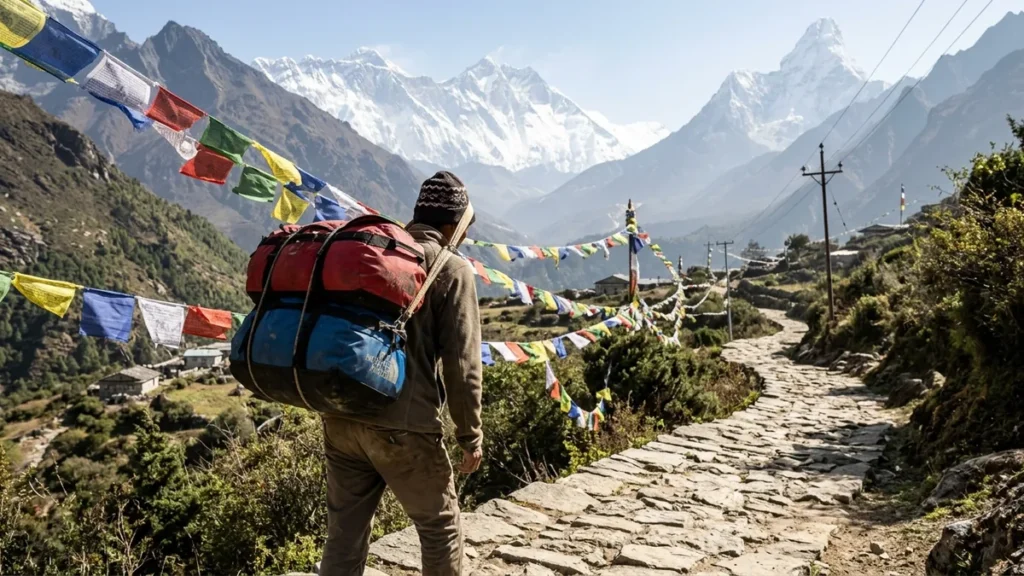
| Crew member | Per day | 10-day trek | 14-day trek |
|---|---|---|---|
| Licensed trekking guide | USD 8–15 | USD 80–150 | USD 110–210 |
| Porter (one per two trekkers) | USD 5–10 | USD 50–100 | USD 70–140 |
| Porter-guide (does both jobs) | USD 8–12 | USD 80–120 | USD 110–170 |
Another common way to calculate the tip for trekking guide and porter teams is 10–15% of the trek price, split across the crew with the guide receiving the larger share. The two methods land in the same place for most groups.
A worked example. A couple on our 14-day Everest Base Camp trek (USD 2,000 each) with one guide and one porter might give the guide about USD 150–200 and the porter about USD 100–140. That’s roughly USD 125–170 each, or 6–9% of what they paid.
Give the tips on the last evening, usually at the farewell dinner in Pokhara or Kathmandu. Give each person their own envelope. Don’t hand the porters’ tips to the guide to pass on, however trustworthy he is. It’s better for everyone when the porter receives his share directly.
Since April 2023, foreign trekkers in Nepal’s national parks and conservation areas must trek with a licensed guide, so every trekker now has a guide to thank. Read what to expect on the 14-day EBC trek or our best treks in Nepal for beginners for how the crew works.
In India, tip in Indian rupees. Tipping drivers in dollars or euros costs them time and money to change, and coins can’t be exchanged at all.
In Nepal, tip in Nepali rupees where you can. Many trekking guides accept US dollars, but small or damaged notes are often refused. NPR is simpler.
Indian notes in Nepal: from July 2026, Nepal Rastra Bank allows travellers to carry Indian ₹200 and ₹500 notes (the new series issued after November 2016) up to ₹25,000 per person. Smaller Indian notes are widely accepted near the border and in tourist areas, but for tips it’s still best to use Nepali rupees.
For current Nepal travel information, including trekking rules, the Nepal Tourism Board is the official source.
Our India tours are priced for the whole vehicle with its driver, not per person. The price covers the car, the driver, fuel, tolls, parking and state taxes, and the driver’s own food and lodging. Hotels, meals, entry tickets and guides are extra, and tipping drivers is always your choice.
| Trip | Sedan (1–3) | SUV (4–5) | Tempo Traveller (6–8) | Suggested driver tip |
|---|---|---|---|---|
| Same-Day Taj Mahal Tour from Delhi | USD 113 | USD 154 | USD 202 | ₹400–800 |
| Golden Triangle Tour, 4 days | USD 356 | USD 488 | USD 640 | ₹1,200–3,200 |
| Golden Triangle Tour, 6 days | USD 534 | USD 732 | USD 960 | ₹1,800–4,800 |
| Rajasthan Grand Circuit, 12 days | USD 1,068 | USD 1,464 | USD 1,920 | ₹3,600–9,600 |
Our Nepal treks are priced per person and include teahouse lodging, all meals on the trek, a licensed guide, a porter, permits and ground transport. Visas, international and domestic mountain flights, insurance and tips are not included.
| Trek (USD per person) | Group 6–8 | Family 4–5 | Couple 2–3 | Solo |
|---|---|---|---|---|
| Everest Base Camp Trek, 14 days | 1,320 | 1,650 | 2,000 | 2,650 |
| Annapurna Base Camp Trek, 11 days | 1,005 | 1,075 | 1,140 | 1,710 |
Everything is private and tailor-made, there’s no booking fee, and the tip is never built into the price. See all our car and driver rates in India.
Tell us your dates, group size and the places you want to see. We reply within 24 hours with a fixed price for the car and driver. If you’d like a detailed day-by-day itinerary, it costs €100, and the full €100 is deducted from your tour price when you book. There is no obligation.
Individuell durch Indien & Nepal
Sagen Sie uns, was Sie lieben, und wir antworten innerhalb von 24 Stunden mit einem Festpreis. Eine ausführliche Tag-für-Tag-Reiseroute kostet €100, die vollständig vom Reisepreis abgezogen werden.
Wählen Sie ein oder mehrere Ziele — Indien und Nepal lassen sich frei kombinieren.
So finden wir das richtige Tempo, die passenden Unterkünfte und Aktivitäten.
Wir antworten innerhalb von 24 Stunden. Niemals Spam.
Before the last day of your trip, run through these eight questions:
If you can answer yes to most of these, the end of your trip will be as easy as the rest of it.
Think of tipping in three layers.
The people who spend days with you, your driver, your trekking guide and porters, get a per-day tip added up and given once at the end. The people who spend hours with you, monument guides, naturalists, boatmen, get a clean amount on the spot. Everyone else gets small notes or nothing, and a service charge on a bill means you’re done.
Use local currency, use an envelope, use your right hand, and remember it’s optional. That’s tipping drivers, guides and porters in India and Nepal without the stress.
For a small group in a sedan, ₹300–500 per day is fair and ₹600 is generous. For 4 to 5 people in an SUV, ₹400–600, and for 6 to 8 in a Tempo Traveller, ₹500–800. Add the days up and give it once, at the end.
Tipping drivers is customary on a multi-day private tour, but it’s always optional. A tip is a thank-you for good service, not part of the driver’s wage, and with us the driver’s pay, food and lodging are already covered.
For a couple in a sedan, about ₹2,100–3,500 for the week is fair, and up to ₹4,200 is generous. For a family in an SUV, about ₹2,800–4,200. Give it in one envelope at the final drop.
At the end. Tipping drivers every day turns the thank-you into an expectation. Prepare one envelope the night before your last day and hand it over before the bags come out at the airport or station.
In rupees. Tipping drivers in foreign notes costs them time and money to change, and coins can’t be exchanged at all. In Nepal, tip in Nepali rupees where you can.
Not on our tours. The driver’s food and lodging are included in our price. Some cheap quotes leave the driver’s allowance for the guest to pay, so check any quote carefully.
For a licensed monument guide, about ₹200–400 for a half day and ₹500–700 for a full day, for the whole group and on top of the guide’s fee. Up to ₹1,000 is fine for an outstanding day.
No. Consumer guidelines from 2022, upheld by the Delhi High Court in March 2025, say restaurants can’t add a mandatory service charge. If it’s on the bill you can ask for it to be removed, and if you pay it, no extra tip is needed.
About USD 8–15 per day, so roughly USD 110–210 for a 14-day trek. The guide usually receives the larger share of the crew tip. Give it directly, in its own envelope, on the last evening.
About USD 5–10 per day, so roughly USD 70–140 for a 14-day trek. Give each porter his own envelope directly rather than passing it through the guide.
A common guideline is 10–15% of the trek price, split across the guide and porters. For most groups this gives a similar answer to the per-day method.
The logic is the same as tipping drivers in India: optional, per day for people who spend days with you, and given at the end. Amounts look bigger in Nepali rupees because NPR is pegged at 1.6 to the Indian rupee.
Smaller Indian notes are widely accepted, and from July 2026 Nepal allows ₹200 and ₹500 notes up to ₹25,000 per person. Nepali rupees are still better for tips.
Porters about ₹20–50 per bag and housekeeping about ₹100 per night are common. Leave housekeeping tips with a short note so they reach the right person.
You don’t have to tip; tipping drivers is always optional. On our tours, please call us the same day so we can fix it while you’re still travelling. That matters more to us than the tip.
Yes. This guide to tipping drivers, guides and porters is written for the October 2026 to June 2027 season, with amounts checked against current Indian and Nepali practice. Exchange rates move, so think in rupees rather than dollars.
A good tip isn’t about the size of the number. It’s about fairness, timing and a proper goodbye.
A per-day amount you’re comfortable with, small notes for the little moments, a separate envelope for each person who looked after you, and a thank-you said face to face. That’s all it takes.
If something wasn’t right, say so. If everything was, say that too. Drivers and guides remember the guests who noticed their work.
Once you plan around those things, tipping drivers becomes the easiest part of the trip. For more practical planning, read our guide to car and driver costs in India, our honest look at driving yourself in India, and whether you need a guide or a driver.
See the 6-day Golden Triangle tour · Car and driver rates in India · Plan my trip