By Khem “Babu” Khadaka, founder, driving these roads since 1996 · Last updated: 2027 season (October 2026 – June 2027)
This Shimla travel guide starts with the thing most visitors get wrong: they treat Shimla as a one-night stop on the way to Manali.
They arrive after dark, walk the Mall for an hour, get stuck in Kufri traffic the next morning, and leave. They never ride the toy train, never see the Viceregal Lodge, and never find the quiet side of the old British summer capital.
Shimla rewards people who slow down. It’s a town built for walking, on seven hills, with a heritage railway, a colonial centre where cars aren’t allowed, and a ring of pine-forest villages within an hour’s drive.
So instead of asking only “What are the best places to visit in Shimla?”, it helps to ask a better question:
How do I see Shimla on foot and by train, at the right time of year, without losing half my trip to traffic?
That’s what this guide is built around. It covers the best places to visit and things to do in Shimla: the Ridge and Mall Road, the Kalka–Shimla toy train with 2026 timings and fares, Jakhoo, the Viceregal Lodge and its new ticket prices, the day trips worth making, when it really snows, the new rules on driving in the town centre, and what a private car and driver costs.
Shimla sits at roughly 2,200 metres on a ridge in the lower Himalayas. From 1864 it was the summer capital of British India, which is why the centre of town looks the way it does: a Gothic church, a Tudor-style theatre, a viceroy’s residence and a long promenade along the top of the hill.
A lot of history happened here. The Simla Conference of 1945 on Indian independence was held at the Viceregal Lodge, and the Simla Agreement between India and Pakistan was signed in the town in 1972.
Today it’s the capital of Himachal Pradesh, and it’s busy. But the old centre is still a walking town, and a short drive in any direction puts you in cedar and pine forest with views to the snow peaks.
The mistake is to judge Shimla by Mall Road on a Saturday in May. Come midweek, or outside the Indian school holidays, and it’s a very different place.
The Ridge is the open square at the top of town and the natural place to start. On clear days you can see a line of snow peaks to the north-east. It’s where the town gathers in the evening, and it’s the venue for the winter carnival and the summer festival.
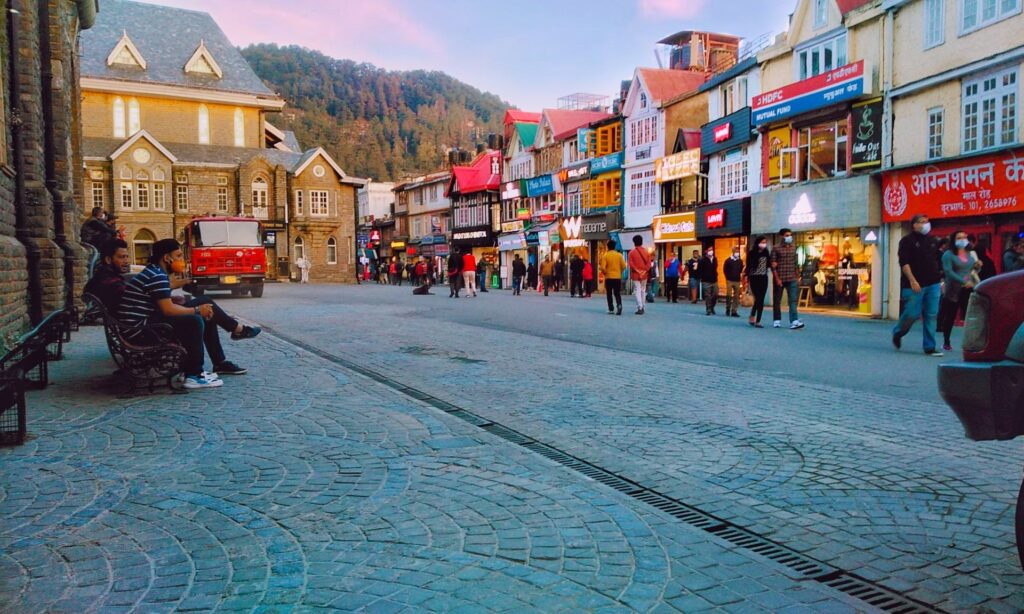
Mall Road runs along the hill just below. It’s lined with old shopfronts, cafés and the Indian Coffee House, which has been serving coffee and dosas on the Mall for decades.
Scandal Point is where the Ridge meets the Mall. The popular legend is that a Maharaja of Patiala eloped with a British official’s daughter from this spot, which got him banned from Shimla. Nobody is quite sure it’s true, but everyone tells it.
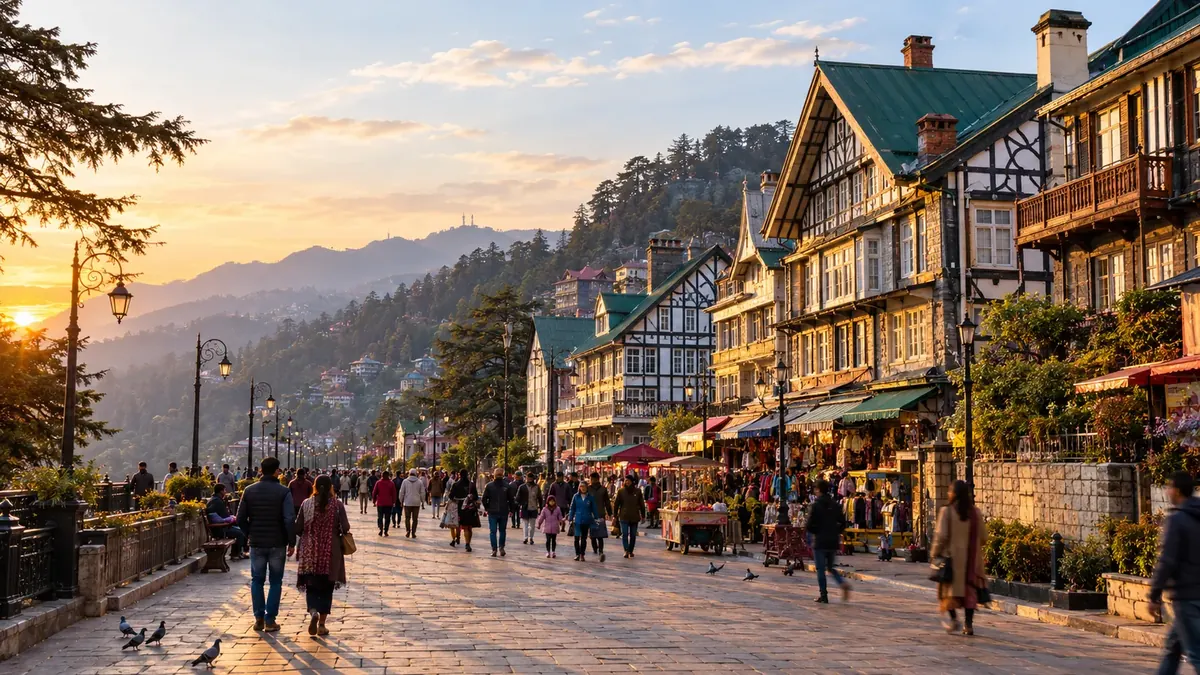
The upper Mall and the Ridge are pedestrian-only, so this whole area is done on foot. Good shoes matter more here than almost anywhere in India, because Shimla is steep.
| Stop | Why go | Time needed |
|---|---|---|
| The Ridge | Views, the town square, sunset | 30–60 minutes |
| Christ Church | Neo-Gothic church and stained glass | 20 minutes |
| Scandal Point | Where the Ridge meets the Mall | 10 minutes |
| Mall Road | Old shopfronts, cafés, people-watching | 1–2 hours |
| Gaiety Theatre | Restored Victorian theatre on the Mall | 20–30 minutes |
| Lakkar Bazaar | Wooden crafts and souvenirs | 30–45 minutes |
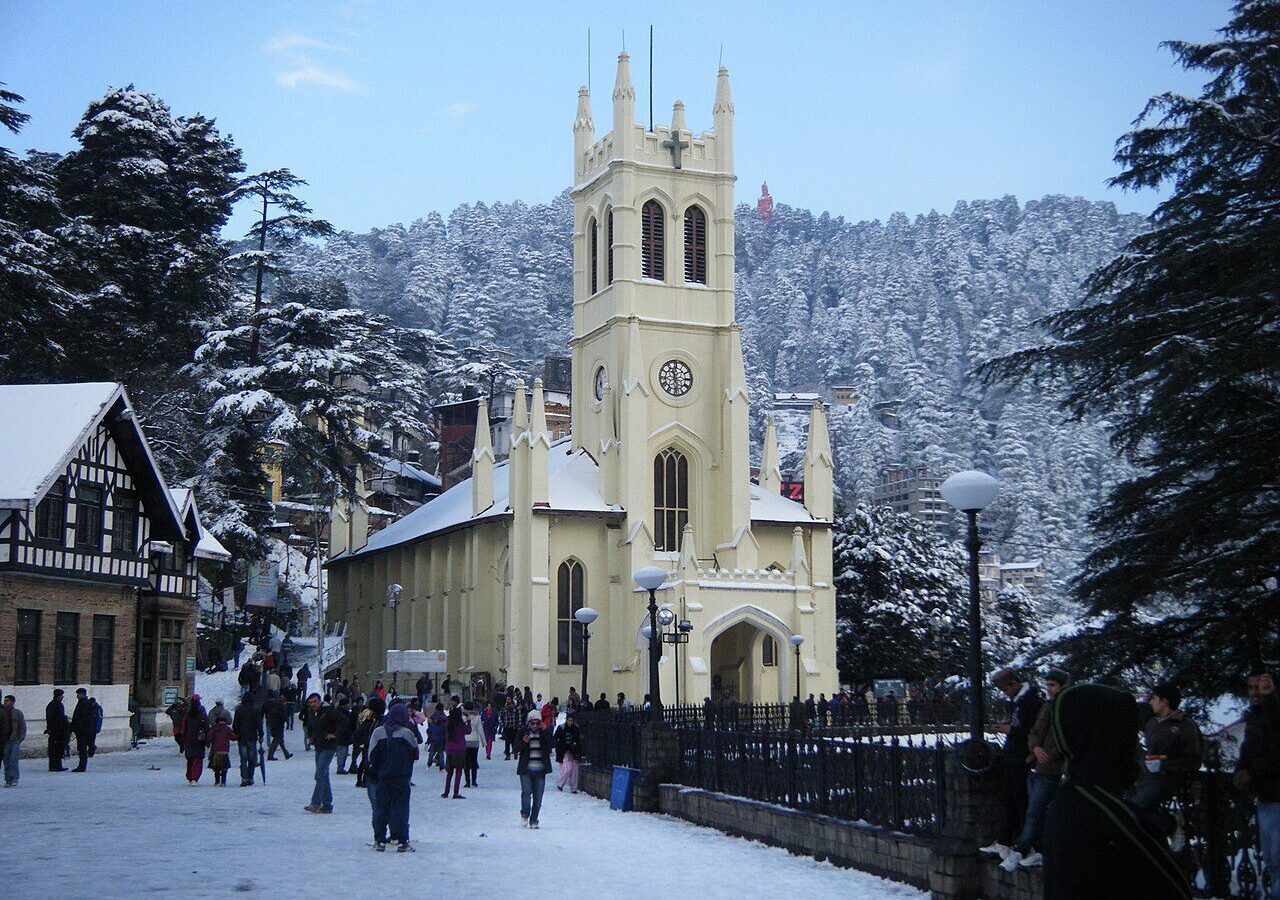
Christ Church is the yellow neo-Gothic church on the Ridge and Shimla’s best-known building. Its foundation stone was laid in 1844 and it was consecrated in 1857. The clock on the tower was added in 1860, and the chancel window was designed by Lockwood Kipling, Rudyard Kipling’s father.
Inside, look for the five stained-glass windows representing Christian virtues. It’s still a working church, so visit quietly and check the timings at the door, as it closes for services.
The Gaiety Theatre on the Mall opened in 1887 as part of the Town Hall complex. It’s been restored and still stages performances. Even if nothing is on, the building is worth a look.
The Kalka–Shimla Railway opened in 1903 and has been a UNESCO World Heritage Site since 2008, as part of the Mountain Railways of India. It’s a narrow-gauge line that climbs about 96 km from Kalka, at the foot of the hills, to Shimla.
The numbers are what make it special: 102 tunnels in use, more than 800 bridges and over 900 curves. The longest tunnel, at Barog, is more than a kilometre long. The ride takes about five hours uphill, so it’s slow. That’s the point.
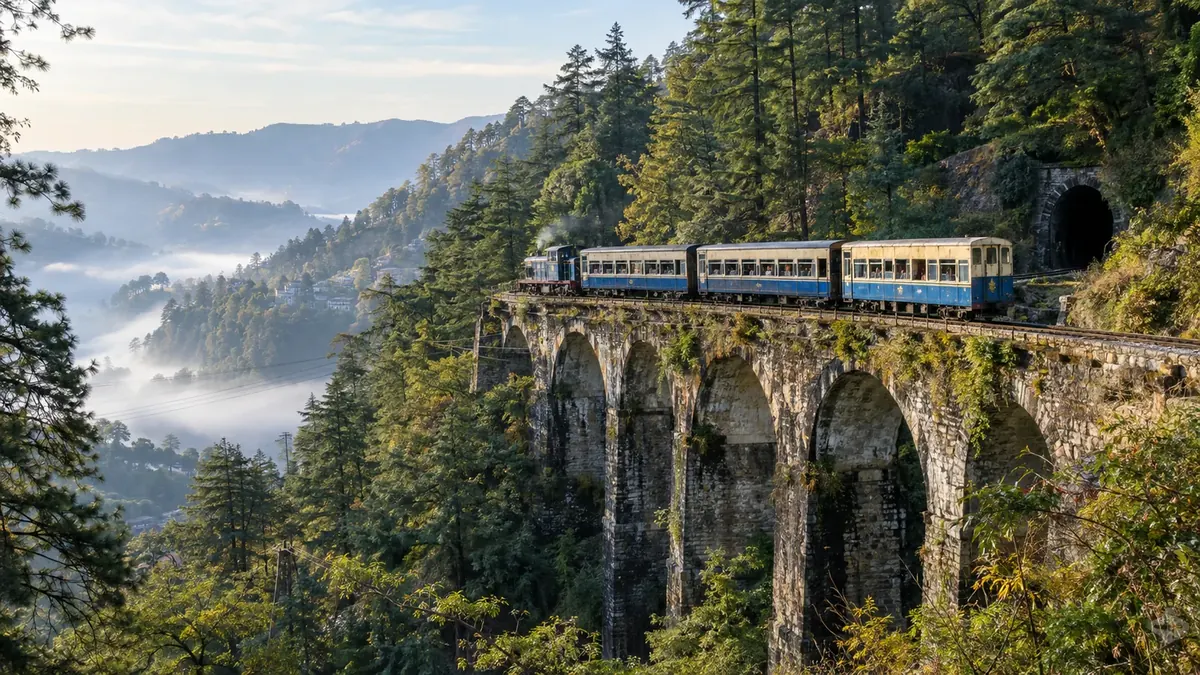
| Train (Kalka to Shimla) | Leaves Kalka | Reaches Shimla | Fare guide |
|---|---|---|---|
| 52457 Kalka Shimla Express | 03:30 | about 08:50 | From about ₹65 |
| 72451 Rail Motor Car | 05:25 | about 09:25 | About ₹320 |
| 52451 Shivalik Deluxe Express | 05:45 | about 10:40 | About ₹595 (first class, meal included) |
| 52453 Kalka Shimla Express | 06:20 | about 11:50 | From about ₹65 |
| 52459 Him Darshan Express (Vistadome) | 07:00 | about 12:20 | About ₹630 (glass-roof AC coach) |
| 52455 Himalayan Queen | around midday | about 17:00 | About ₹265–475 |
Times and fares are as published for 2026. Indian Railways changes them, so check on IRCTC before you book. Book early for October, May and June. The toy train fills up weeks ahead.
How to book the Shimla toy train: tickets are sold on IRCTC like any Indian train, and reservations open up to 60 days ahead. Foreign visitors can book on IRCTC with an international account, or we can help you book. Book the Vistadome and the Shivalik Deluxe first, as they have the fewest seats.
Which one to take? If you’re coming from Delhi the same day, the classic combination is the Kalka Shatabdi (leaves New Delhi at 07:40, reaches Kalka around 11:40) connecting to the Himalayan Queen. The Vistadome and the Shivalik Deluxe are the most comfortable, but they leave Kalka early in the morning, so you’d need to stay the night before near Kalka or Chandigarh.
A tip most people don’t know: you don’t have to ride all five hours. Many of our guests drive up with us and ride just the prettiest section, from Barog or Solan to Shimla, while the driver carries the luggage and meets them at Shimla station. You get the tunnels and bridges without the long early start.
Monsoon warning: the line is closed by landslides in heavy monsoons. In 2023 a bridge at Summer Hill was washed away and the track was shut for more than two months. If you’re travelling in July, August or early September, have a road back-up.
Jakhu, also spelt Jakhoo, is the highest of Shimla’s seven hills, at around 2,450 metres. At the top is an old temple to Hanuman and, since 2010, a 108-foot (33-metre) orange Hanuman statue that you can see from most of the town.
You can walk up from the Ridge in 30 to 45 minutes. It’s steep, and worth it for the views. Or take the Jakhoo ropeway, which does the climb in a few minutes for a few hundred rupees return.
A serious word about the monkeys: Jakhoo is famous for them, and they’re bold. They snatch sunglasses, phones, food and even hats. Put everything in a zipped bag before you go up, and don’t carry snacks in your hand.
The Viceregal Lodge on Observatory Hill was built between 1884 and 1888 as the summer residence of the viceroys of India. It’s a grand grey-stone building in a Scottish baronial style, with lawns and views across the valley. Today it houses the Indian Institute of Advanced Study.
It’s the best building in Shimla to visit, and many people miss it because it’s a 20-minute walk or short drive west of the Mall.
| What | Detail |
|---|---|
| Open | 9:30 a.m. to 5:00 p.m. |
| Closed | Mondays and national holidays |
| Foreign nationals | ₹1,000 per person (age 5 and over) |
| Indian nationals | ₹200 per person |
| Children 6–12 and students | ₹50 |
| Guided tour | About 30 minutes, in English and Hindi, roughly every half hour from 10:30 a.m. |
| Photography | Allowed outside, not inside the main building |
These rates took effect on 1 March 2026 (see the Indian Institute of Advanced Study visitor page). Go in the morning, and don’t turn up on a Monday.
Lakkar Bazaar, just past the Ridge, is known for wooden walking sticks, toys and carved souvenirs. Lower Bazaar, below the Mall, is where locals actually shop: narrow lanes of spices, woollens, shawls and small eateries.
For food, try Himachali dishes rather than the pizza on the Mall. Siddu is a steamed wheat bread stuffed with poppy seeds or walnuts and served with ghee. Chana madra is chickpeas cooked in yoghurt with spices. If you’re lucky enough to be invited to a wedding or festival meal, the traditional Himachali dham is served on leaf plates.
For an old-Shimla atmosphere, have coffee at the Indian Coffee House on the Mall, with its waiters in white uniforms and fan-shaped turbans.
The best of Shimla is often just outside it. With a car and driver, these are easy half-day or full-day trips.

| Place | Distance from Shimla | Why go |
|---|---|---|
| Kufri | About 16 km | Higher and snowier than Shimla; pony rides to Mahasu Peak |
| Mashobra | About 12 km | Quiet apple orchards and forest walks |
| Naldehra | About 23 km | Deodar forest and one of India’s oldest golf courses |
| Chail | About 45 km | Former palace of the Maharaja of Patiala and one of the world’s highest cricket grounds |
| Narkanda | About 60 km | Hatu Peak views and the best winter snow near Shimla |
About Kufri: it’s the most famous and the most crowded. The pony ride up to Mahasu Peak usually costs about ₹400–700 and takes 30–40 minutes. Agree the price and what it includes before you get on, and go on a weekday before 10 a.m. to avoid long queues and traffic jams.
If you’d rather have mountain views without the crowds, Narkanda and Hatu Peak are the better choice, especially in winter.
Many visitors plan a trip to Shimla in December expecting snow and find none. Shimla town does get snow, but it isn’t guaranteed.
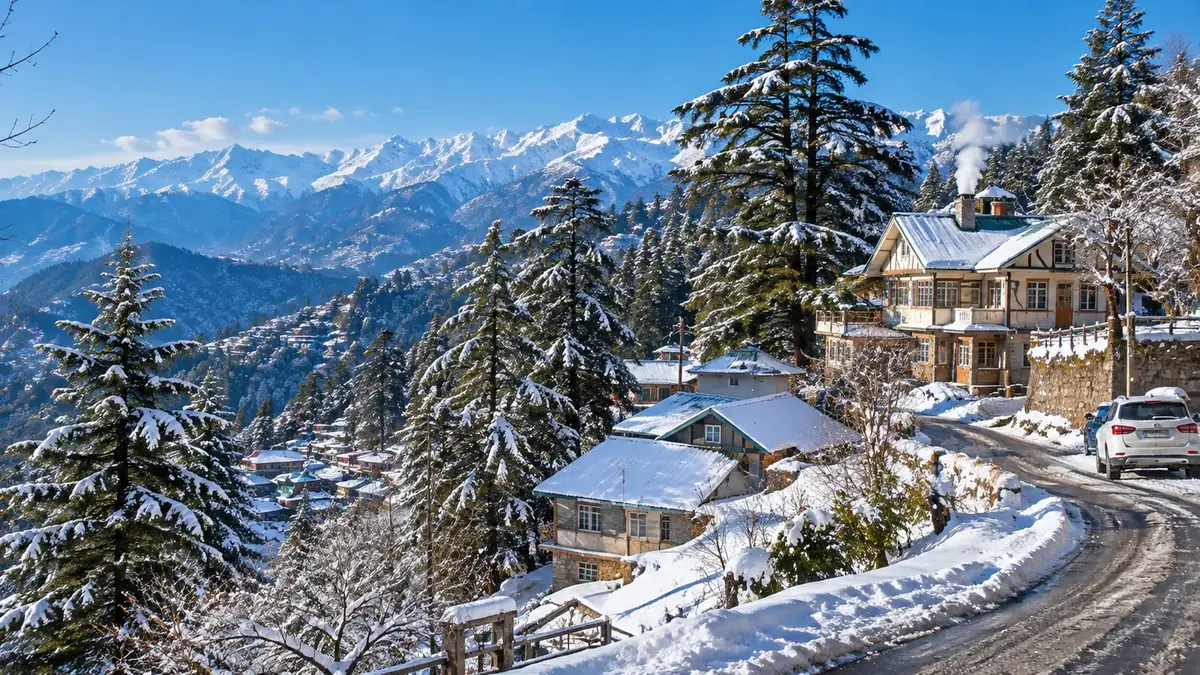
Kufri and Narkanda are several hundred metres higher than Shimla and get noticeably more snow. If snow is the whole point of your trip, stay flexible and base yourself so that you can drive up when it falls.
After heavy snow, roads around Shimla can close for a day or two while they’re cleared. Our drivers carry chains and know when to wait. Please trust them when they say it’s better not to drive.
The Shimla Winter Carnival is held on the Ridge and Mall Road around Christmas and New Year, with music, food stalls and folk performances. It’s festive, and the hotels are full, so book early.
The Delhi to Shimla distance is about 350 km by road. Here’s how the options compare:
| Option | Time | Good for |
|---|---|---|
| Private car from Delhi | 8–9 hours (about 350 km) | Door-to-door, stops on the way, luggage |
| Kalka Shatabdi and toy train | About 4 hours to Kalka, then about 5 hours on the toy train | The heritage experience |
| Overnight Volvo bus | 9–10 hours | Budget travellers |
| Fly to Chandigarh, then drive | 45-minute flight, then about 3–4 hours by road (115 km) | Saving time at the start |
| Fly to Shimla (Jubbarhatti) | About 1 hour | Only when a flight is actually running |
By car: the road runs through Panipat, Ambala and Chandigarh, then climbs from Parwanoo through Dharampur and Solan to Shimla. The last two to three hours are in the hills. A new four-lane highway and a Chandigarh–Shimla expressway are being built and are due around 2027, and parts of the road are already faster. Until it’s finished, plan on a full day and leave Delhi early.
By air: Shimla’s airport at Jubbarhatti, about 23 km from town, has a short runway and only a few small Alliance Air flights, which are often cancelled for weather. Don’t build your trip around it. Flying into Chandigarh, which has frequent flights from Delhi, is more reliable.
Coming from further north? See our Amritsar travel guide. Amritsar to Shimla is a long day, usually broken at Chandigarh.
This catches people out. The heart of Shimla (the Ridge, the upper Mall and several roads around them) is a sealed or restricted zone where private and tourist cars can’t go without a special permit.
In April 2026 the Himachal assembly tightened the rules. Driving on a sealed road without a permit can now bring a fine of ₹15,000, and daily permits for tourist vehicles have risen to ₹1,000. Permits are meant for limited cases, not for sightseeing.
So in practice, your driver drops you on Cart Road below the Mall, usually at the Lift, a public lift that carries you up to the Mall for a small ticket, or near the Victory Tunnel. You walk from there. It’s the nicest way to see the town anyway.
Parking in Shimla is tight, and weekend traffic on the approach roads can be slow. Hiring a driver who knows the town is worth it here more than almost anywhere else, because he deals with the parking while you walk.
A new urban ropeway linking Taradevi with the town centre has been approved, but it’s years behind schedule. Don’t plan around it for 2027.
Shimla sits high enough to stay cool all year. These are the long-term averages for the town:
| Month | Average high | Average low | Rain |
|---|---|---|---|
| January | 9 °C | 2 °C | Low; snow possible |
| February | 10 °C | 2 °C | Low; snow possible |
| March | 15 °C | 6 °C | Low |
| April | 20 °C | 11 °C | Low |
| May | 23 °C | 14 °C | Moderate |
| June | 24 °C | 15 °C | Rising (monsoon arrives late June) |
| July | 21 °C | 15 °C | Very heavy |
| August | 21 °C | 14 °C | Very heavy |
| September | 20 °C | 13 °C | Easing |
| October | 19 °C | 11 °C | Very low |
| November | 15 °C | 7 °C | Very low |
| December | 12 °C | 4 °C | Very low; snow possible late in the month |
So when is the best time to visit Shimla? It depends what you want:
| Months | Weather | Verdict |
|---|---|---|
| March–April | Mild days, cool nights, rhododendrons in bloom | Very good, and quieter than May |
| May–June | Warm days, around 16–25 °C | Good weather but peak crowds, especially at weekends |
| July–August | Monsoon rain, cloud and landslides | Avoid if you can |
| September–November | Clear skies, crisp air, best mountain views | The best overall |
| December–February | Cold, near freezing at night, chance of snow | Best for snow and the winter carnival |
Our pick is late September to mid-November. The monsoon has cleared the haze, the views to the high Himalaya are at their sharpest, and the summer crowds have gone.
The Shimla Summer Festival on the Ridge usually takes place in late May or early June. It’s fun, but Shimla is at its busiest then.
Here’s the honest answer:
Shimla fits naturally with Manali. The Shimla to Manali distance is about 250 km, a 7 to 8 hour drive along the Sutlej and Beas rivers through Mandi and Kullu. Read our Manali travel guide for the second half of the trip.
| When | Day 1: the old town | Day 2: out of town |
|---|---|---|
| Morning | Viceregal Lodge (not on a Monday) | Early start to Kufri or Narkanda, before the traffic |
| Midday | Lunch on the Mall; Gaiety Theatre | Mashobra or Naldehra, lunch in the forest |
| Afternoon | Walk or ropeway up to Jakhoo | Back to town; Lakkar Bazaar and Lower Bazaar |
| Evening | Sunset on the Ridge, Christ Church lit up | Coffee on the Mall, dinner of Himachali food |
If you arrive on the toy train, do Day 1 the following morning. You’ll arrive tired, and the Ridge at dusk is all you need that first evening.
Near the Mall and the Ridge: the most convenient base, because you can walk everywhere. Heritage hotels such as The Oberoi Cecil and Clarke’s Hotel are on the Mall. Check how far the hotel is from the nearest road. Some are a steep walk with luggage, and porters are common.
Mashobra, Chharabra and Kufri side: quieter, greener and cooler, with valley views. Wildflower Hall at Chharabra is the best-known luxury choice. You’ll need the car to get into town.
Chail or Naldehra: for a slow stay in the forest rather than a sightseeing base.
We don’t book hotels or take commission from them, so this advice is honest. We’ll gladly suggest places that suit your budget and give you the parking details.
Most of our Shimla guests combine it with Manali. Our 8-day Shimla and Manali tour from Delhi (Delhi → Shimla → Manali → Chandigarh → Delhi) is priced for the whole vehicle with its driver, not per person:
| Vous voyagez | Véhicule | 8-day tour price |
|---|---|---|
| 1 to 3 travellers | Berline | USD 800 |
| 4 to 5 travellers | SUV | USD 1,096 |
| 6 to 8 travellers | Tempo Traveller | USD 1,440 |
That covers the car, the driver, fuel, tolls, parking and state taxes, including Himachal Pradesh’s entry tax on out-of-state vehicles. Hotels, meals, the toy train, the Viceregal Lodge and other entry fees are extra.
Want Shimla on its own, or with Amritsar, Dharamshala or Rishikesh? We’ll build the route for you at our published car and driver day rates. See how driver pricing works in India. Tipping your driver is always your choice (see our tipping guide).
Tell us your dates, how many of you are travelling and what you want to see. We reply within 24 hours with a fixed price for the car and driver. If you’d like a detailed day-by-day itinerary, it costs €100, and the full €100 is deducted from your tour price when you book. There is no obligation.
Sur mesure en Inde & au Népal
Dites-nous ce que vous aimez et nous répondons sous 24 heures avec un prix fixe. Un itinéraire détaillé jour par jour coûte €100, entièrement déduits du prix du circuit.
Choisissez une ou plusieurs destinations — vous pouvez combiner librement l’Inde et le Népal.
Cela nous aide à trouver le bon rythme, les bons hébergements et les bonnes activités.
Nous répondons sous 24 heures. Jamais de spam.
Before you finalise your trip, run through the eight questions at the heart of this Shimla travel guide:
If you can answer yes to most of these, your Shimla trip will go smoothly.
Think of Shimla in three layers.
The old town, on foot: the Ridge, Christ Church, the Mall, Jakhoo and the Viceregal Lodge. The railway: at least part of the toy train, the reason Shimla is on UNESCO’s list. The hills around it: Kufri, Mashobra, Naldehra, Chail and Narkanda, which you reach by car.
Get the season right, give it two nights, and let someone else do the mountain driving. Then this Shimla travel guide has done its job.
Two nights is right for most people. That covers the Ridge, Mall Road, Jakhoo, the Viceregal Lodge and one day trip to Kufri, Mashobra or Naldehra. Add a third night for Chail or Narkanda.
Late September to mid-November for clear skies and the best mountain views. March to June is also pleasant but busy. Come in January for the best chance of snow, and avoid July and August because of monsoon landslides.
Sometimes. The first proper snowfall usually comes in the second half of December, if at all. January is the most reliable month, and Kufri and Narkanda, which are higher, get more snow than Shimla town.
About 350 km by road, which takes 8 to 9 hours by car. By train it’s about 4 hours to Kalka on the Shatabdi, then about 5 hours on the Kalka–Shimla toy train.
For comfort, the Vistadome (Him Darshan Express) or the Shivalik Deluxe Express, but both leave Kalka early in the morning. Coming from Delhi the same day, most people take the Kalka Shatabdi and connect to the Himalayan Queen around midday.
About five hours uphill for the 96 km journey, through 102 tunnels and over more than 800 bridges. You can also ride just part of the line, for example from Barog or Solan.
Yes. It was added in 2008 as part of the Mountain Railways of India, alongside the Darjeeling and Nilgiri mountain railways.
No. The Ridge, the upper Mall and several nearby roads are sealed or restricted, and driving there without a permit can bring a fine of up to ₹15,000. Drivers drop visitors on Cart Road, usually at the Lift, and you walk up.
From 1 March 2026 it’s ₹1,000 for foreign nationals, ₹200 for Indian nationals and ₹50 for children aged 6 to 12 and students. It’s open 9:30 a.m. to 5 p.m. and closed on Mondays and national holidays.
Yes, if you’re careful. The monkeys grab sunglasses, phones and food, so pack everything into a zipped bag before you go up and don’t carry snacks in your hand.
Yes. They pair naturally. The drive between them is about 250 km and 7 to 8 hours. Our 8-day Shimla and Manali tour from Delhi gives Shimla two nights and Manali four.
Yes, at Jubbarhatti, about 23 km from town, but flights are few and often cancelled for weather. Flying to Chandigarh and driving 3 to 4 hours is more reliable.
Our 8-day Shimla and Manali tour from Delhi costs USD 800 for a sedan (1 to 3 travellers), USD 1,096 for an SUV (4 to 5) and USD 1,440 for a Tempo Traveller (6 to 8), for the whole vehicle including fuel, tolls, parking and state taxes.
It’s worth it if you go early on a weekday and want snow or the pony ride to Mahasu Peak (about ₹400–700). At weekends the traffic and queues can be bad. Narkanda is a quieter alternative for mountain views.
Cool all year. Average highs are about 9 °C in January and 23–24 °C in May and June, with nights near freezing in winter. July and August bring very heavy monsoon rain, and October and November are dry and clear.
Book on IRCTC like any Indian train. Reservations open up to 60 days ahead, and the Vistadome and Shivalik Deluxe sell out first, especially in October, May and June.
About 250 km by road, which takes 7 to 8 hours through Mandi and the Kullu valley.
Yes. It’s written for the October 2026 to June 2027 season. Train times, entry fees and road rules change, so confirm them before you travel.
A good Shimla trip isn’t about ticking off viewpoints. It’s about timing and pace.
Two nights, not one? The right season? A seat on the toy train? Kufri on a weekday morning? Comfortable shoes for a town with no cars in the centre? A driver who knows where to drop you?
If the answer is yes, you’ll see the Shimla that made the British move their government up the mountain every summer. If not, you’ll see traffic.
Once you plan around those things, using this Shimla travel guide becomes simple. For more of the hills, read our Manali travel guide or our Amritsar travel guide, or see all our Shimla tours.
See the 8-day Shimla and Manali tour · Car and driver rates in India · Plan my trip