By Khem “Babu” Khadaka, founder, driving these roads since 1996 · Last updated: 2027 season (October 2026 – June 2027)
The car and driver cost in India looks simple until the final bill arrives. A quote of ₹12 a kilometre sounds cheap; then come the 250 km daily minimum, the driver’s allowance, night charges, tolls, parking, state taxes and GST.
None of those extras is a scam. They’re how the Indian taxi trade has always priced outstation trips. The problem is that visitors compare a bare per-km rate with an all-inclusive tour price and think one is half the other, when the real gap is much smaller.
The other problem is that price is only half of it. The driver you spend a week with matters more than any single line on the bill.
So instead of asking only “What is the cheapest rate per kilometre?”, it helps to ask a better question:
What will the whole trip cost once every charge is added, what exactly is included, and what kind of car and driver am I getting for that price?
That’s what this guide answers. It explains per-km and per-day pricing, typical 2026 market rates for a sedan, an SUV and a Tempo Traveller, the 250 km minimum, what should be included, the hidden-cost traps, how state taxes and the All India Tourist Permit work, a worked example for a 7-day Golden Triangle, and our own whole-vehicle prices for the main tours.
To estimate the car and driver cost on a multi-day trip, most visitors should budget for a daily figure rather than a per-km rate. Once all the extras are included, a sedan with a driver costs roughly ₹3,000–4,500 a day on the plains in 2026, an Innova Crysta roughly ₹4,500–6,500, and a Tempo Traveller more again.
Those are market figures for local operators. International tour operators, including us, charge more, because the price includes things a local taxi firm usually doesn’t: a driver used to foreign guests, a fixed price with no extras, planning, and support throughout the trip.
The rest of this guide shows you how those figures are built, so you can compare any two quotes fairly and understand the true car and driver cost.
There are three common ways to work out car and driver cost in India. Each can be fair; the trick is knowing which one you’re being quoted.
| Pricing model | Comment ça marche | Watch out for |
|---|---|---|
| Per km (outstation) | A rate per kilometre, with a minimum number of km charged per day, plus a driver allowance | The daily minimum, and extras charged at actual cost |
| Local package (8 hours / 80 km) | A fixed price for a day within one city; extra km and extra hours charged on top | Whichever limit you pass first triggers extra charges |
| Per day or fixed package | One price for the whole vehicle for the whole trip | Make sure tolls, parking, taxes and allowances are really included |
Per km is the standard for outstation trips booked with local taxi firms. It’s transparent in theory, but the final car and driver cost depends on the route, the minimum, and how many extras are added.
Local packages are for sightseeing in a single city, such as a full day in Delhi or Jaipur.
Fixed packages are what tour operators sell. You pay one price for the car and driver for the whole itinerary, and the operator carries the risk of extra kilometres, tolls and taxes.
These are typical advertised car and driver cost rates from local operators in north India in 2026. Rates vary by city and season, and many operators quote lower headline figures and add more extras.
| Véhicule | Seats (comfortably) | Outstation rate per km | Local 8 hr / 80 km day |
|---|---|---|---|
| Sedan (Swift Dzire, Honda Amaze type) | 1–3 adults with luggage | About ₹10–17 | About ₹1,400–2,500 |
| MUV (Maruti Ertiga type) | 3–4 | About ₹13–16 | About ₹1,800–2,300 |
| SUV (Toyota Innova Crysta) | 4–5 | About ₹18–22 | About ₹2,400–3,500 |
| Tempo Traveller (9–12 seats) | 6–8 with luggage | About ₹23–32 | About ₹3,600–5,000 |
On top of the per-km rate, most operators add a driver allowance of about ₹300–500 a day, and charge tolls, parking and state entry taxes at actual cost. Many add 5% GST at the end.
Some operators advertise an all-inclusive day rate for foreign visitors instead. A common pattern is around ₹3,000 a day for a sedan, ₹4,500 for an Innova and ₹6,000 for a minivan, with tolls, taxes and the driver’s costs included. Always ask what’s in it.
This is the single biggest cause of confusion in any car and driver cost comparison. On an outstation trip, almost every operator charges a minimum of 250 km per day, and some charge 300 km, whether or not you drive that far.
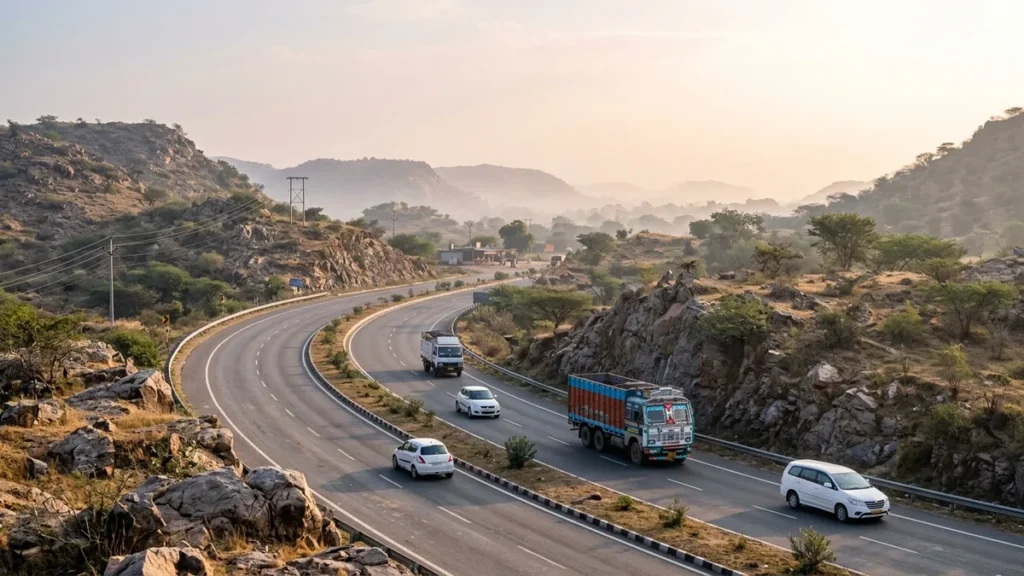
The reason is simple: the car and driver are yours for the day and can’t earn anything else. So a rest day in Agra is billed at 250 km, even if the car never leaves the hotel.
| Day | Actual driving | Billed at (250 km minimum) |
|---|---|---|
| Delhi sightseeing | About 60–80 km | 250 km |
| Delhi → Agra | About 230 km | 250 km |
| Agra sightseeing | About 30–50 km | 250 km |
| Agra → Jaipur (via Fatehpur Sikri) | About 240 km | 250 km |
| Jaipur sightseeing | About 40–60 km | 250 km |
| Jaipur → Delhi | About 280 km | 280 km |
| Total (6 days) | About 880–940 km | About 1,530 km |
So on a 6-day Golden Triangle the car and driver cost is based on around 1,500 km, not the 880–940 km you actually drive. At ₹13 a km, that’s about ₹19,900 for the kilometres alone, before the allowance, tolls, parking, taxes and GST.
Two consequences follow. First, a per-km quote that doesn’t mention the minimum is incomplete. Second, one-way drops cost more than you’d expect, because the car has to come back empty.
Before you compare the car and driver cost in any two quotes, line them up against this list. A quote that leaves several of these out isn’t cheaper; it’s unfinished.
| Item | Typical cost if charged separately | Included in our price? |
|---|---|---|
| Fuel | Built into the per-km rate | Yes |
| Tolls | About ₹400–700 per long day on main highways | Yes |
| Parking at monuments and hotels | About ₹50–300 per stop | Yes |
| State entry taxes and permits | Varies by state and vehicle | Yes |
| Driver’s daily allowance (food) | About ₹300–500 a day | Yes |
| Driver’s night stay | About ₹300–500 a night, or a room | Yes |
| Night driving charge | Often added after about 10 p.m. | We plan routes to avoid long night drives |
| GST | 5% on the total | Yes |
| Hotels, meals and entry tickets for you | Your own costs | No |
| Guides | Hired locally per monument or per day | No (we recommend licensed guides) |
That last pair matters. Our India tours are transport only: the car, the driver and everything that keeps them on the road. Your hotels, meals, tickets and guides are separate, which lets you choose your own standard and pay only for what you use.
These three lines cause more awkward moments than anything else in the car and driver cost, so it’s worth knowing how they work.

A daily sum, usually ₹300–500, that pays for the driver’s meals on the road. With a local operator it’s normally billed to you per day. With us it’s included, and you never need to pay the driver for his food.
When the trip is outstation, the driver needs somewhere to sleep. Many hotels in tourist towns have simple drivers’ rooms or dormitories; some have nothing, and drivers end up sleeping in the car. A local quote may add a night charge of about ₹300–500, or ask you to cover a room.
We include the driver’s lodging in our price and make sure he has a proper place to rest. A rested driver is a safer driver.
Many operators add a charge for driving between about 10 p.m. and 6 a.m. It’s partly a safety surcharge and partly compensation for long hours. We plan itineraries to avoid long night drives. If your flight lands late at night, ask how the operator handles the pick-up before you book.
Tourist taxis in India are commercial vehicles, and crossing a state border has traditionally meant paying an entry tax, usually charged per day or per seat. On a Golden Triangle you cross from Delhi into Uttar Pradesh, Rajasthan and back, and in the hills into Himachal Pradesh or Uttarakhand.
Since 2023, vehicles registered under the All India Tourist Vehicles (Permit) Rules pay a single national permit fee, which is shared among the states, and states are not meant to charge separate border taxes on them. In practice, some states have kept collecting their own entry taxes, and Himachal Pradesh has been in a long dispute with the central government over it (The Tribune, May 2025).
What this means for your car and driver cost: ask whether state taxes are included, and whether the car has an All India Tourist Permit. Vehicle and permit details can be checked on the government’s Parivahan portal. Our prices include all state taxes, whatever the route.
Highway tolls are paid electronically by FASTag. Since 15 November 2025, a vehicle without a valid FASTag pays double the toll in cash, or 1.25 times by UPI (All India Radio report). Any professional taxi has a FASTag; tolls should simply be passed on at cost or included.
Most operators in India are honest. But these are the ways a car and driver cost can creep up on a trip:
The vehicle affects the car and driver cost more than anything except the number of days. Choose by people and luggage, not by seats alone.
| Group | Véhicule | Why |
|---|---|---|
| 1–3 travellers | Berline | Comfortable for three with suitcases; the lowest cost |
| 4–5 travellers | SUV (Toyota Innova Crysta type) | Three rows, more legroom and boot space; better for long days |
| 6–8 travellers | Tempo Traveller | A proper mini-coach with space for everyone’s luggage |
Don’t try to squeeze four adults and four large suitcases into a sedan to save money. After a five-hour drive you’ll wish you hadn’t.
The Innova Crysta is the workhorse of Indian touring: reliable, roomy and good on bad roads. For three travellers who want extra space, it’s often worth the step up.
The car and driver cost for a single city is lower. If you only need a car in one city, say a full day of sightseeing in Delhi, a local 8-hour/80 km package is the right product. In 2026 that’s roughly ₹1,400–2,500 for a sedan and ₹2,400–3,500 for an Innova Crysta with local operators, plus parking and any extra hours.
Extra time is charged by the hour, and extra distance by the kilometre, whichever limit you cross first. A long Delhi day that starts at 8 a.m. and ends after dinner will usually go over.
App-based cabs are fine for single rides within a city. For a sightseeing day with stops, a car that waits for you is easier and often not much dearer.
For a day trip from Delhi to Agra, see our same-day Taj Mahal guide. That’s a long 12–14 hour day and is priced as its own trip.
Two quotes with the same car and driver cost can be very different trips. This is what separates them.
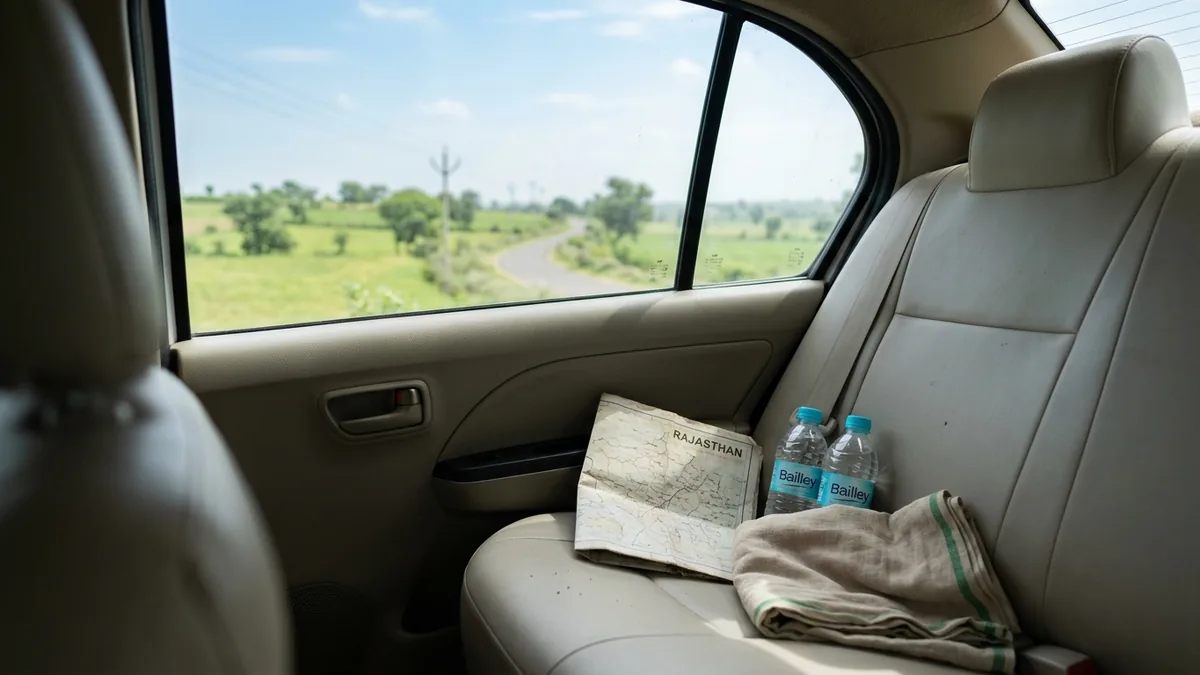
A driver isn’t a guide, and he isn’t allowed to guide inside monuments. For how drivers and licensed guides work together, read our guide or driver explainer.
If you’re weighing a hired car against driving yourself, our guide to driving yourself in India sets out the costs and risks.
Here’s the car and driver cost for the same trip, Delhi → Agra → Jaipur → Delhi over 7 days in a sedan, priced three ways. The local figures are estimates using 2026 market rates.
| Local operator, per km | Local operator, all-in day rate | GoIndiaNepal fixed price | |
|---|---|---|---|
| Billed distance | 7 days × 250 km minimum ≈ 1,750 km | Not relevant | Not relevant |
| Kilometres (₹12–14 per km) | About ₹21,000–24,500 | Included | Included |
| Driver allowance (7 days) | About ₹2,100–3,500 | Included | Included |
| Tolls, parking, state taxes | About ₹2,500–4,000 at cost | Usually included; check | Included |
| GST | 5% on top | Check | Included |
| Approximate total | About ₹27,000–34,000 | About ₹21,000 (7 × ₹3,000) | USD 623 |
| Driver experienced with foreign guests | Not guaranteed | Varies | Yes |
| Planning and support from the operator | Varies | Varies | Yes |
So what does this car and driver cost comparison show? That the headline per-km rate is not the price, and that the cheapest local quotes, once completed, land well above their headline.
Our car and driver cost is higher than a local taxi rank’s, and we’d rather say so plainly. What it buys is a fixed figure with nothing added, a driver we know and trust, and a company that answers the phone. See our guide to how many days the Golden Triangle needs before you fix the length.
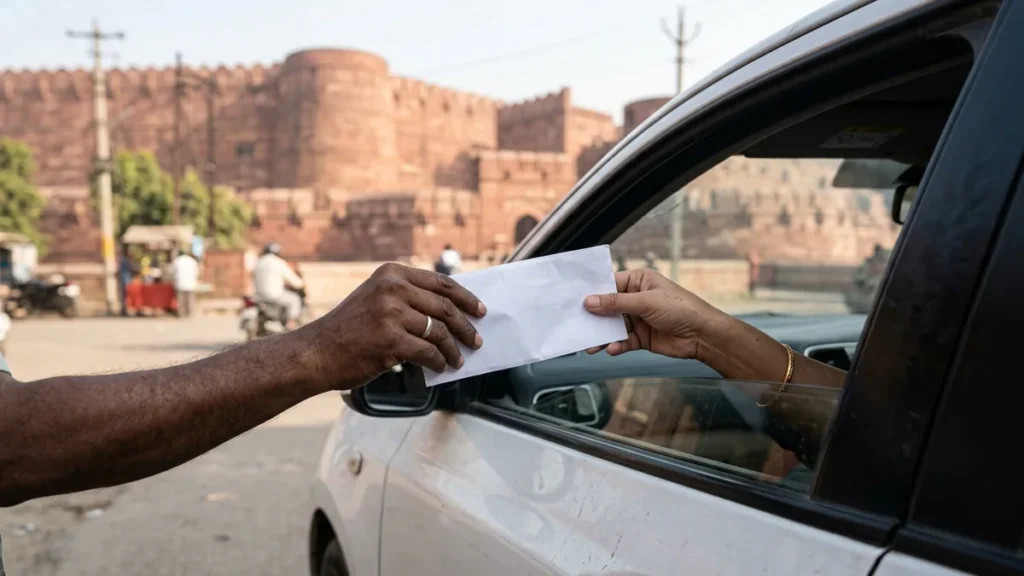
Tipping your driver is always optional. If you’re happy with the service, a tip at the end of the trip in an envelope is the usual way. Our tipping guide for drivers in India and Nepal gives typical amounts per day.
Other costs on a car-and-driver trip are your own: hotels, meals, monument tickets, guides, and any activities such as a safari or a boat ride. Budget for them separately. Together they’re often larger than the car and driver cost itself.
Travelling in Nepal too? Car prices there work differently, with mountain roads and different taxes. See our car and driver in Nepal page.
These are our published prices for the whole vehicle with its driver, not per person. Every price includes the car, the driver, fuel, tolls, parking, state taxes and the driver’s own food and lodging:
| Circuit | Sedan (1–3) | SUV (4–5) | Tempo Traveller (6–8) |
|---|---|---|---|
| Same-Day Taj Mahal Tour from Delhi | USD 113 | USD 154 | USD 202 |
| Delhi Sightseeing by Car, 2 days | USD 178 | USD 244 | USD 320 |
| Golden Triangle Tour, 4 days | USD 356 | USD 488 | USD 640 |
| Golden Triangle Tour, 6 days | USD 534 | USD 732 | USD 960 |
| Golden Triangle Tour, 7 days | USD 623 | USD 854 | USD 1,120 |
| Golden Triangle with Ranthambore, 8 days | USD 712 | USD 976 | USD 1,280 |
| Golden Triangle, Khajuraho and Varanasi, 10 days | USD 890 | USD 1,220 | USD 1,600 |
| Rajasthan Grand Circuit, 12 days | USD 1,068 | USD 1,464 | USD 1,920 |
| Shimla and Manali, 8 days | USD 800 | USD 1,096 | USD 1,440 |
| Char Dham Yatra by Road, 12 days | USD 1,272 | USD 1,740 | USD 2,280 |
On the plains, that works out at about USD 89 a day for a sedan, USD 122 for an SUV and USD 160 for a Tempo Traveller. Mountain routes cost a little more per day because of the harder driving and higher taxes.
Not included: hotels, meals, entry tickets and guides. Everything is private and tailor-made, and there’s no booking fee. For any other route, we quote at our published car and driver rates, or build a tailor-made India tour around your dates.
Tell us your route, dates and group size. We reply within 24 hours with a fixed price for the car and driver. If you’d like a detailed day-by-day itinerary, it costs €100, and the full €100 is deducted from your tour price when you book. There is no obligation.
Sur mesure en Inde & au Népal
Dites-nous ce que vous aimez et nous répondons sous 24 heures avec un prix fixe. Un itinéraire détaillé jour par jour coûte €100, entièrement déduits du prix du circuit.
Choisissez une ou plusieurs destinations — vous pouvez combiner librement l’Inde et le Népal.
Cela nous aide à trouver le bon rythme, les bons hébergements et les bonnes activités.
Nous répondons sous 24 heures. Jamais de spam.
Before you accept any quote, check these eight things:
If the answer to all eight is yes, you’re comparing like with like.
Think of car and driver cost in India as three layers: the kilometres (with the daily minimum), the driver’s costs (allowance and night stay), and the road costs (tolls, parking, state taxes and GST).
A per-km quote shows you the first layer. A fixed price shows you all three. Compare totals, not headline rates, and then compare the driver and the support behind him.
Do that, and the car and driver cost stops being a mystery and becomes one clear number you can plan around.
With a local operator in 2026, roughly ₹3,000 to ₹4,500 a day for a sedan and ₹4,500 to ₹6,500 for an Innova Crysta once all extras are added. Our all-inclusive Golden Triangle tours work out at about USD 89 a day for a sedan and USD 122 for an SUV.
Typical 2026 outstation rates are about ₹10 to ₹17 per km for a sedan, ₹18 to ₹22 for an Innova Crysta and ₹23 to ₹32 for a Tempo Traveller, usually with a minimum of 250 to 300 km a day.
On outstation trips, most operators charge at least 250 km per day, even on days when you drive less, because the car and driver are reserved for you. Some charge a 300 km minimum.
A daily amount, usually ₹300 to ₹500, that covers the driver’s meals. With local operators it’s often billed separately, sometimes with a night charge for his lodging. Our prices include both.
It depends on the quote. Many local operators charge tolls, parking and state taxes at actual cost on top. Our whole-vehicle prices include all of them.
Not with us; the driver’s food and lodging are included. With some local operators you pay a night allowance or cover a driver’s room, so ask before you book.
Yes, taxi and car-with-driver services usually carry 5% GST. Some quotes include it and some add it at the end, so check.
An SUV such as the Toyota Innova Crysta. It has three rows and much more luggage space than a sedan, which matters on long drives.
A local 8-hour, 80 km package costs roughly ₹1,400 to ₹2,500 for a sedan and ₹2,400 to ₹3,500 for an Innova Crysta in 2026, plus parking and any extra hours or kilometres.
Because the car usually has to drive back empty, and the daily minimum applies to the return. A one-way drop often costs close to a short round trip.
A national permit for tourist vehicles under rules issued in 2023. The permit fee is shared among the states, and states are not meant to charge separate border taxes, though some still collect entry taxes.
Many operators add a charge for driving roughly between 10 p.m. and 6 a.m. We plan routes to avoid long night drives, so the question rarely arises on our tours.
Tipping is optional. If the service was good, a tip in an envelope at the end of the trip is normal. Our tipping guide suggests typical daily amounts in rupees and dollars.
Self-drive rental can look cheaper, but you take on insurance, fuel, tolls, parking, navigation and the stress of Indian traffic. Most visitors find a driver safer and better value.
USD 534 for a sedan, USD 732 for an SUV and USD 960 for a Tempo Traveller on our 6-day tour, for the whole vehicle including fuel, tolls, parking, state taxes and the driver’s costs.
Yes. It’s written for the October 2026 to June 2027 season using 2026 market rates. Fuel prices, tolls and taxes change, so treat local figures as a guide and ask for a written quote.
A good car-and-driver trip isn’t about the lowest rate per kilometre. It’s about knowing the full price and trusting the person at the wheel.
A fixed total, or a per-km quote with the minimum stated? Tolls, parking, taxes, GST and the driver’s costs included? The right vehicle for your luggage? A driver who speaks your language?
If yes, you’ll have one less thing to think about for the whole trip.
Once you know those, working out your car and driver cost is simple. For more planning help, read our guide to driving from Delhi to Jaipur, our guide or driver explainer and our Golden Triangle tour guide.
See the 6-day Golden Triangle tour · Car and driver rates in India · Plan my trip