By Khem “Babu” Khadaka, founder, driving these roads since 1996 · Last updated: 2027 season (October 2026 – June 2027)
“Guide or driver: which one do I need?” is one of the first questions people ask when they plan a private tour of India, and it usually rests on a misunderstanding.
Many visitors expect the person who drives them from Delhi to Agra to walk them round the Taj Mahal and tell its story. Others book a guide for every stop, including places where there’s nothing to explain. Both lose out: the first group gets a man who waits in the car park, the second pays for hours of commentary they didn’t need.
In India the two jobs are separate by law and by custom. Your driver handles the road. A licensed guide handles the monument. The skill is knowing where each one earns its keep.
So instead of asking only “Do I need a guide in India?”, it helps to ask a better question:
At which sites will a licensed guide change what I understand, where will an audio guide or my own reading do, and what should my driver be doing all day?
That’s what this guide sets out. It explains what a driver does and doesn’t do, why drivers can’t guide inside monuments, who licensed guides are and how to spot one, typical guide fees in 2026, a site-by-site verdict for the Golden Triangle, Varanasi and Khajuraho, audio-guide alternatives, how the guide or driver question works in Nepal, and how our car-and-driver model fits it all together.
You don’t have to choose. For a road trip in north India you want both, but in different amounts.
The driver is with you every day, from the airport to the final drop. He plans the timings, handles traffic, parking and tolls, knows where to eat on the highway, and keeps you safe on the road.
The guide joins you for a few hours at a time, at the places where history, architecture or religion need explaining. In Agra that might be four hours; in Jaipur a morning; in Varanasi a dawn boat ride and an afternoon in the lanes.
The guide or driver question, then, isn’t either-or. It’s about which sites deserve a guide, and trusting your driver with everything else.
A good driver makes or breaks a private tour of India. But in any guide or driver split, his job is the road, not the history.
| Your driver will | Your driver won’t |
|---|---|
| Drive you safely between cities and around town | Guide you inside the Taj Mahal, forts or temples |
| Plan start times around traffic, closures and crowds | Give a licensed historical commentary |
| Drop you at the right gate and meet you afterwards | Enter monuments with you as a guide |
| Handle parking, tolls, fuel and paperwork | Take you shopping unless you ask |
| Suggest clean places to eat on the road | Drive long hours at night if it’s unsafe |
| Help with luggage at hotels | Replace a guide in Varanasi’s lanes |
Our drivers speak enough English to talk through the plan, answer practical questions and share a bit about their home region. Some know a lot. But a driver chatting about the Mughals in the car park isn’t the same as a licensed guide explaining the inlay work in front of you.
When people weigh guide or driver, they often forget what a driver does very well: timing. Arriving at the Taj Mahal at sunrise, reaching Amber Fort before the tour buses, avoiding Friday at the Taj and Monday at the Red Fort: that planning is worth more than any commentary.
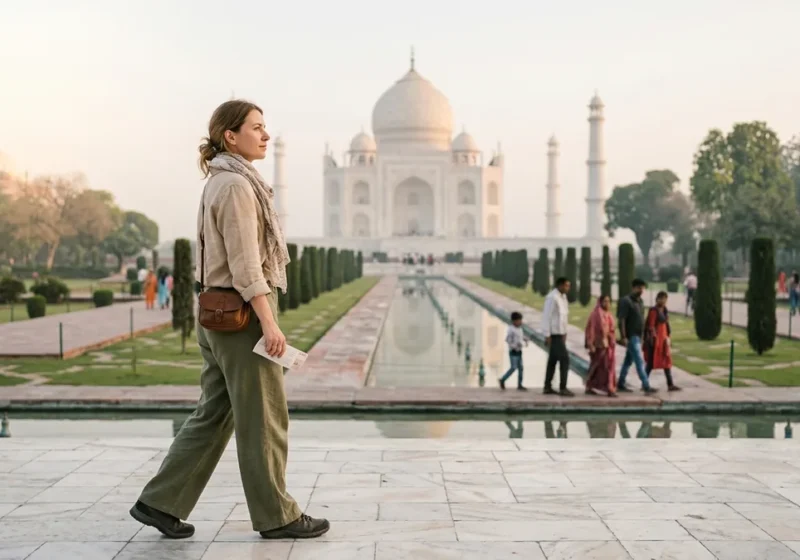
At the Taj Mahal and other sites protected by the Archaeological Survey of India (ASI), only licensed guides are permitted to work. The official Taj Mahal visitor rules tell visitors to hire only authorised guides who carry an identity card.
That’s why your driver stops at the car park. At the Taj Mahal, cars can’t go near the gates at all: petrol and diesel vehicles are kept out of a zone around the monument, and you take a battery bus or golf cart from the parking area.
The rule is enforced unevenly. Unlicensed guides, known locally in Agra as lapkas, gather in car parks and approach new arrivals. In 2024 a visiting ambassador was even shown round Fatehpur Sikri by one, which made the national news (Gulf News report).
So when you weigh guide or driver for a monument day, the answer at ASI sites is simple: the driver brings you there, and a licensed guide or an audio guide takes you inside.
India has several layers of licensed guides. To settle guide or driver sensibly you don’t need the paperwork, just the categories:
| Type | Licensed by | Where they work |
|---|---|---|
| Regional-level guides | The Ministry of Tourism (Government of India), through its regional offices | Across a region such as north India; often the most experienced and multilingual |
| State-level guides | State tourism departments, such as Rajasthan Tourism | Throughout that state |
| Local or site guides | State or local authorities | One city or one monument |
All carry a photo ID card. The Ministry of Tourism has also run online training and certification for guides and tourist facilitators since 2020 under its Incredible India Tourist Facilitator programme.
Many licensed guides speak excellent English, and in Agra, Delhi and Jaipur you can find guides in French, Spanish, German, Italian, Japanese and other languages. Book those ahead; there are fewer of them.
If you’re deciding guide or driver on the spot at a monument, these rules keep you safe:
A guide who spends the whole tour steering you towards a shop isn’t a guide at all. The best ones don’t mention shopping unless you raise it.
Cost is part of the guide or driver decision. Official rate cards for licensed guides exist, but they’re old and often far below what guides charge today. Market rates depend on the city, the language, the group size and the length of the tour.

| Where | Typical tour | Rough 2026 market rate (small group, English) |
|---|---|---|
| Agra | Taj Mahal and Agra Fort, half day (about 4 hours) | About ₹1,000–2,500 |
| Agra | Taj Mahal only, at the gate | About ₹500–1,000 |
| Jaipur | Amber Fort, City Palace, Jantar Mantar, half to full day | About ₹1,000–2,500 |
| Delhi | Old and New Delhi, full day | About ₹1,500–3,000 |
| Varanasi | Dawn boat ride and old city walk | About ₹1,500–3,000 |
| Any city | Non-English language (French, Spanish and so on) | Usually more; book ahead |
These are approximate ranges, not official fees. Some Rajasthan rate cards still list a few hundred rupees for a group of one to four, and some specialist guides charge much more. Private “expert” guides booked through agencies often cost ₹1,500–3,000 for a half day.
Guide fees don’t include your entry tickets. At the Taj Mahal, foreign visitors pay ₹1,100 plus ₹200 for the main mausoleum; in Jaipur, Amber Fort has cost foreigners ₹1,000 since January 2026. Tipping a good guide is optional and appreciated; our tipping guide gives typical amounts.
This is our honest verdict on the guide or driver question at the main sites, based on what our guests tell us afterwards.
| Site | Guide? | Why |
|---|---|---|
| Taj Mahal, Agra | Yes | The story, the calligraphy and inlay, the optical tricks; a guide also keeps touts away |
| Agra Fort | Yes | A complex site; the guide links it to the Taj and Shah Jahan’s last years |
| Fatehpur Sikri | Yes | Large, confusing layout and heavy touting; the history makes the ruins come alive |
| Red Fort, Delhi | Optional | Good with a guide; the free audio guide app works well too |
| Humayun’s Tomb, Delhi | Optional | Easy to explore; audio guide is enough for most |
| Qutub Minar, Delhi | Optional | Compact; a guide adds the story of the iron pillar and the mosque |
| Old Delhi (Chandni Chowk, Jama Masjid) | Yes | Lanes, food and etiquette; a local guide or walking tour is far better |
| Amber Fort, Jaipur | Yes | Big, layered palace; a guide explains the zenana and Sheesh Mahal |
| City Palace and Jantar Mantar, Jaipur | Yes, especially Jantar Mantar | The instruments make little sense without explanation |
| Varanasi ghats and old city | Yes | Rituals, cremation-ghat etiquette and the maze of lanes |
| Khajuraho temples | Yes | Sculpture and iconography are the whole point |
Plenty of stops don’t need a guide at all. Your driver drops you, you look, you move on.
On these days the guide or driver balance tilts fully to the driver. He knows where to drop you, how long to allow and where to meet.
If you prefer to explore at your own pace, audio guides add a third option to the guide or driver choice. The Ministry of Tourism’s free Audio Odigos app, developed with the ASI under the Adopt a Heritage scheme, covers the Taj Mahal, the Red Fort, Humayun’s Tomb and Fatehpur Sikri in English, Hindi, Korean and Japanese.
Download the content at your hotel before you go; mobile data can be patchy inside thick walls. Bring earphones. At the Taj, headphones are on the list of items that may be refused at security, so wired earbuds in a pocket are the safest choice.
A good guidebook or a short history of the Mughals read the night before adds a lot too. Our guests who do their homework often use a guide only at the Taj and Fatehpur Sikri, and audio everywhere else.
Some operators blur the guide or driver line and sell a “driver-guide” or “chauffeur-guide” in India. In most cases that means a driver who speaks good English and will talk about the places you pass. That’s useful, but it isn’t a licensed guide, and he can’t legally guide you inside the Taj Mahal or other ASI monuments.
In practice, a driver-guide package either drops you at the gate and hires a local guide on the spot, or leaves you on your own inside. Ask exactly what happens at each monument before you book.
We keep the roles clear. Our drivers drive, and we recommend licensed local guides where they add something. That’s more honest, and it usually means a better guide at each site.
A guide is only as good as the brief you give them, whichever way you settle guide or driver. Once you’ve settled guide or driver for each stop, spend five minutes on this:

If you’re travelling with us, we arrange the meeting point so the driver drops you straight to the guide at the right gate, and collects you when you finish.
Nepal answers guide or driver a little differently. For touring by road between Kathmandu, Pokhara, Chitwan and Lumbini, the pattern is the same as India: a private driver for the journey and a local guide for the heritage sites of the Kathmandu valley, where licensed guides work at the Durbar Squares, Pashupatinath and Boudhanath.

For trekking, the rules are stricter. Since April 2023, foreign trekkers in Nepal’s national parks and conservation areas have been required to trek with a licensed guide, with a few exceptions such as the Everest region, where local rules differ. On our treks the guide and porter are included in the per-person price.
See our car and driver in Nepal page for touring, and our best treks in Nepal for beginners for how trekking guides work.
Here’s how we’d split the guide or driver roles on a typical 6-day Golden Triangle:
| Day | Driver | Guide |
|---|---|---|
| 1. Delhi | Airport pick-up, hotel | None |
| 2. Delhi | All day | Old Delhi walk and the Red Fort in the morning; audio guide at Humayun’s Tomb |
| 3. Delhi → Agra | Drive; Mehtab Bagh at sunset | None |
| 4. Agra | Hotel to Taj parking at sunrise; Agra Fort | Licensed guide for the Taj and Agra Fort (about 4 hours) |
| 5. Agra → Jaipur | Drive via Fatehpur Sikri | Local licensed guide at Fatehpur Sikri (about 1.5 hours) |
| 6. Jaipur | All day | Guide for Amber Fort, City Palace and Jantar Mantar; Hawa Mahal on your own |
That’s three to four guided sessions in six days, with the driver doing everything else: a guide or driver plan that costs little and covers what matters. For how many days to give each city, see our Golden Triangle days guide and the 6-day itinerary.
Our India tours are transport only. We give you a private car and an experienced driver for the whole trip, at a published price for the whole vehicle. On the guide or driver question, guides are optional: we recommend licensed local guides we trust, and you pay them locally, only where you want one.
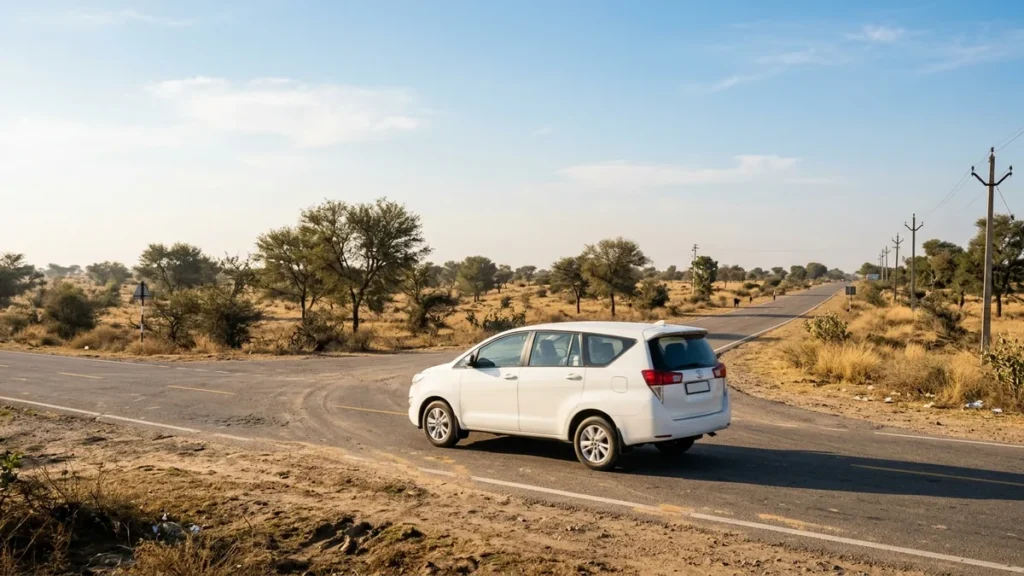
These are our prices for the most popular routes, for the whole vehicle with its driver:
| Circuit | Sedan (1–3) | SUV (4–5) | Tempo Traveller (6–8) |
|---|---|---|---|
| Same-Day Taj Mahal Tour from Delhi | USD 113 | USD 154 | USD 202 |
| Delhi Sightseeing by Car, 2 days | USD 178 | USD 244 | USD 320 |
| Golden Triangle Tour, 4 days | USD 356 | USD 488 | USD 640 |
| Golden Triangle Tour, 6 days | USD 534 | USD 732 | USD 960 |
| Golden Triangle, Khajuraho and Varanasi, 10 days | USD 890 | USD 1,220 | USD 1,600 |
Included: the car, the driver, fuel, tolls, parking, state taxes, and the driver’s own food and lodging.
Not included: hotels, meals, entry tickets and guides. That keeps the price clear and lets you choose exactly how much guiding you want. See our car and driver rates and our guide to car and driver costs for how pricing works.
Tell us your dates, your route and where you’d like a guide. We reply within 24 hours with a fixed price for the car and driver. If you’d like a detailed day-by-day itinerary, it costs €100, and the full €100 is deducted from your tour price when you book. There is no obligation.
Sur mesure en Inde & au Népal
Dites-nous ce que vous aimez et nous répondons sous 24 heures avec un prix fixe. Un itinéraire détaillé jour par jour coûte €100, entièrement déduits du prix du circuit.
Choisissez une ou plusieurs destinations — vous pouvez combiner librement l’Inde et le Népal.
Cela nous aide à trouver le bon rythme, les bons hébergements et les bonnes activités.
Nous répondons sous 24 heures. Jamais de spam.
Before you finalise your trip, run through these eight questions:
If you can answer yes to most of these, you’ve got the balance right.
Think of guide or driver as two jobs, not a choice. The driver owns the road: timing, safety, parking and logistics, every day. The guide owns the monument: story, meaning and context, for a few hours at the places that need it.
Book the driver for the whole trip, a licensed guide at the Taj, Agra Fort, Fatehpur Sikri, Amber Fort, Old Delhi and Varanasi, and use audio or your own reading for the rest.
Do that, and the guide or driver question answers itself.
Usually both; guide or driver is not an either-or choice. A driver for the whole road trip handles travel, timing and parking. A licensed guide is worth hiring at a few major sites such as the Taj Mahal, Agra Fort, Fatehpur Sikri, Amber Fort, Old Delhi and Varanasi.
No. Only licensed guides are permitted to work inside the Taj Mahal and other ASI-protected monuments. Drivers drop you at the parking area, and you take a battery bus or golf cart to the gate.
In Agra and Jaipur, a licensed English-speaking guide for a half day usually costs roughly ₹1,000 to ₹2,500 for a small group in 2026. A full day in Delhi or a Varanasi boat and old-city tour is often ₹1,500 to ₹3,000. Other languages cost more.
Ask to see the photo ID card and check the name, photo and expiry. Be wary of anyone who approaches you in a car park or outside the gate, and book through your hotel or operator where possible.
Yes for most people. A guide explains the story, the calligraphy and the inlay work, shows you the best photo angles and keeps touts away. Allow about three to four hours with Agra Fort.
Yes. The free Audio Odigos app from the Ministry of Tourism covers the Taj Mahal, Red Fort, Humayun’s Tomb and Fatehpur Sikri in English, Hindi, Korean and Japanese. Download it before you arrive.
At Amber Fort, the City Palace and Jantar Mantar a guide adds a lot, especially at Jantar Mantar. Hawa Mahal and Jal Mahal are fine on your own, so in Jaipur the guide or driver answer is a guide for the morning and the driver for the rest.
Yes, we recommend one. The rituals, the cremation-ghat etiquette and the maze of lanes are hard to understand alone, and a dawn boat ride is far better with someone who can explain what you see.
Usually a driver who speaks good English and talks about the places you pass. He is not a licensed guide and can’t legally guide inside ASI monuments, so ask what happens at each site before booking.
No. Our India tours cover the car, driver, fuel, tolls, parking and state taxes. Guides are optional; we recommend licensed local guides and you pay them directly only where you want one.
Tipping is optional. If a guide did a good job, a tip at the end is appreciated. Our tipping guide suggests typical amounts for guides and drivers.
At major sites you can, but check the ID card carefully and agree the price and duration first. Booking ahead through your hotel or operator is safer and gives you a better choice of guides.
Yes. In Agra, Delhi and Jaipur there are licensed guides in French, Spanish, German, Italian, Japanese and other languages. There are fewer of them, so book in advance.
Yes, in most cases. Since April 2023 foreign trekkers in Nepal’s national parks and conservation areas have been required to trek with a licensed guide. Our treks include a licensed guide and porter.
Three or four sessions on a 6-day trip is typical: Old Delhi or the Red Fort, the Taj Mahal with Agra Fort, Fatehpur Sikri, and Amber Fort with the City Palace. The driver handles everything else; that’s the guide or driver balance we recommend.
Yes. It’s written for the October 2026 to June 2027 season, with 2026 entry fees and market guide rates. Rates vary by city and language, so agree the price before you start.
The best private tours of India feel effortless because the roles are clear. The driver gets you there, on time and safely. The guide makes the place mean something.
A driver for every day? A licensed guide at the Taj, Agra Fort, Fatehpur Sikri, Amber Fort and Varanasi? An audio guide downloaded for the rest? No shopping stops?
If so, you’ll get the best of both, and pay only for what adds value.
Once that’s clear, the guide or driver decision is simple. For more planning help, read our car and driver cost guide, our Delhi to Agra same-day guide and our Golden Triangle tour guide.
See the 6-day Golden Triangle tour · Car and driver rates in India · Plan my trip