By Khem “Babu” Khadaka, founder, driving these roads since 1996 · Last updated: 2027 season (October 2026 – June 2027)
A golden triangle tour is the most popular first trip to India for a simple reason: in one short loop by road you see Delhi, the Taj Mahal in Agra and the pink city of Jaipur.
It’s also the trip most often done badly. People arrive in Agra on a Friday, when the Taj is shut, see Jaipur in a single afternoon, or book a cheap group coach that stops at three carpet shops for every monument.
None of that is necessary. The three cities sit roughly 230 to 280 km apart on good highways, the monuments are world class, and with the right order and the right number of days the whole circuit is relaxed.
So instead of asking only “What does a golden triangle tour include?”, it helps to ask a better question:
In what order, in which season and at what pace should I see Delhi, Agra and Jaipur, so that every day works and nothing important is missed?
That’s what this guide is built around. It explains the route and drive times, how many days you need, the best months, what to see in each city, the 2026–27 entry fees (Jaipur’s went up in January 2026), the closure days that catch people out, the add-ons worth making, private car versus train versus group tour, and what a private golden triangle tour costs with us.
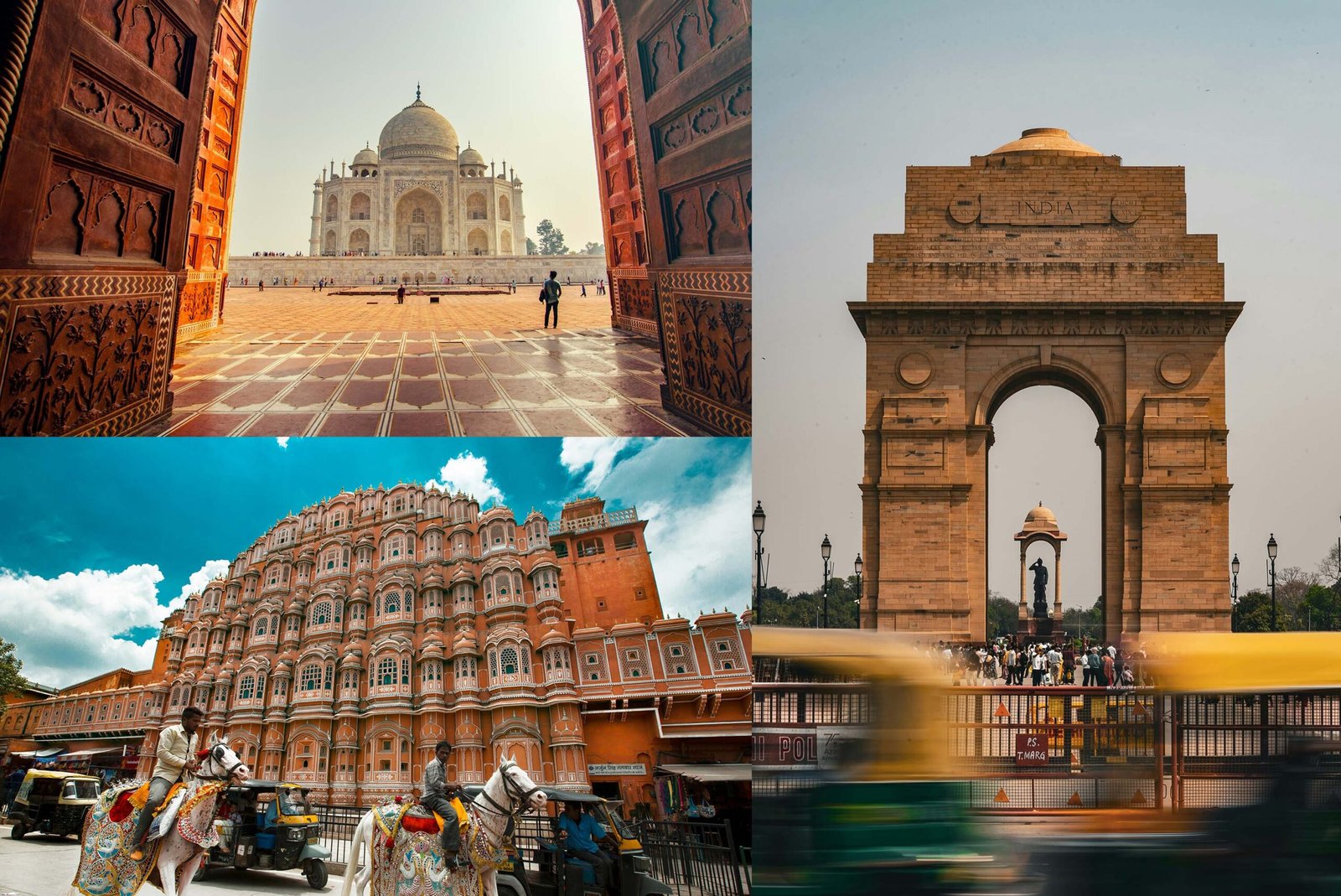
The Golden Triangle is the name the travel trade gives to the three-city circuit of Delhi, Agra and Jaipur. On a map the three cities form a rough triangle, and between them they hold seven UNESCO World Heritage Sites.
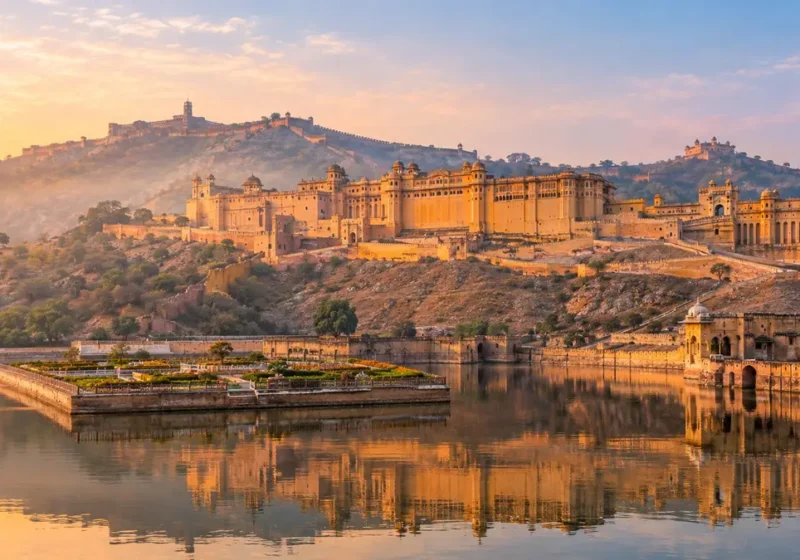
In Agra there are the Taj Mahal and Agra Fort, with Fatehpur Sikri just outside the city. Delhi has Humayun’s Tomb, the Qutub Minar complex and the Red Fort. Jaipur has Jantar Mantar, the walled city itself and Amber Fort, which is listed as one of the Hill Forts of Rajasthan.
The attraction is density: nowhere else in India can you see so much of the Mughal and Rajput story in so few days.
What a golden triangle tour is not: a complete picture of India. It’s the north’s greatest hits. That’s why most of our guests add something on, such as tigers in Ranthambore, Varanasi on the Ganges, or the lakes of Udaipur.
Most people start and finish in Delhi, because that’s where the international flights land. The usual loop runs clockwise: Delhi to Agra, Agra to Jaipur, then Jaipur back to Delhi.
| Leg | Distance | Drive time | Road |
|---|---|---|---|
| Delhi → Agra | About 230 km | 3–4 hours | Yamuna Expressway |
| Agra → Jaipur | About 240 km | 4–5 hours (plus stops) | NH21 via Bharatpur and Dausa |
| Jaipur → Delhi | About 280 km | 4–6 hours | NH48, or the Delhi–Mumbai Expressway via Dausa |
| Whole loop | About 750 km | 3 driving days | All good dual carriageway or expressway |
Why clockwise? The Agra–Jaipur leg passes Fatehpur Sikri, about 40 km west of Agra, so you can see it without doubling back. The Chand Baori stepwell at Abhaneri is a short detour off the same road.
The Jaipur–Delhi road has changed. Since July 2025 a 67 km link from Jaipur’s Ring Road to the Delhi–Mumbai Expressway near Bandikui has been open. On a clear day it takes an hour or more off the old NH48 drive. The slow part is still the last stretch into Delhi.
The loop works the other way round too. Starting with Jaipur can help if your dates would otherwise land you in Agra on a Friday. We’ll check that for you when we plan the route. For a leg-by-leg look at the road, read our Delhi to Jaipur by car guide.
This is the golden triangle tour question we’re asked most, and the answer depends on how much you want to see rather than how far you drive.
| Length | What it feels like | Who it suits |
|---|---|---|
| 3 jours | Rushed: one monument per city, long drives | Only if you have no other choice |
| 4 jours | Tight but workable; one full day per city | Short stopovers, business travellers |
| 5–6 days | Relaxed; sunrise at the Taj, a proper Jaipur day, time to rest | Most first-time visitors |
| 7–8 days | Room for Ranthambore or a slow second Jaipur day | Wildlife lovers, families |
| 10+ days | Add Varanasi, Khajuraho, Udaipur or Amritsar | People who want more than the highlights |
Our view: six days is the sweet spot for a first golden triangle tour. You get two nights in Delhi to recover from the flight, one night in Agra so you can see the Taj at sunrise, and two nights in Jaipur, which has more to see than people expect.
If four days is all you have, it can work, but you have to accept what you’ll miss. Our 4-day golden triangle itinerary shows exactly how. For the relaxed version, see the 6-day golden triangle itinerary, and if you’re still undecided, our guide to how many days the Golden Triangle needs compares 3 to 7-day plans side by side.
The Golden Triangle is on the hot northern plains, so the season matters more than people think. These are the long-term averages for Agra; Delhi and Jaipur are similar.
| Month | Average high | Average low | Verdict |
|---|---|---|---|
| January | 22 °C | 7 °C | Good; cold nights, morning fog can delay trains and flights |
| February | 26 °C | 10 °C | Excellent |
| March | 32 °C | 14 °C | Very good early; warming by the end. Holi falls on 22 March 2027 |
| April | 38 °C | 20 °C | Hot; sightseeing early morning and late afternoon only |
| May–June | 41–42 °C | 24–26 °C | Very hot; possible, but plan around midday heat |
| July–August | 33–36 °C | 24–25 °C | Monsoon: humid, green, heavy downpours |
| September | 34 °C | 24 °C | Rain easing; hot and sticky |
| October | 35 °C | 19 °C | Good, warm days; the season starts |
| November | 29 °C | 13 °C | Excellent; Diwali falls on 8 November 2026 |
| December | 24 °C | 8 °C | Very good; busy at Christmas, fog some mornings |
Our pick is mid-October to mid-March, and the very best weeks are usually November and February: dry, clear, warm by day and cool at night.
About winter fog: from late December to mid-January, dense fog can settle over the plains in the early morning. It rarely stops a car tour, but it can blur a Taj sunrise and delay early trains and flights. Our drivers slow down and wait for it to lift, and we build a little slack into winter itineraries.
Summer and monsoon: a golden triangle tour in May or July is doable in an air-conditioned car. Start at dawn, rest through the midday heat, and go out again in the evening.
More golden triangle tour plans fail on the calendar than on the road. Check these before you fix your dates:
| Place | Closed | What to do instead |
|---|---|---|
| Taj Mahal, Agra | Every Friday (open for Friday prayers only) | See Agra Fort and Mehtab Bagh; both open on Fridays |
| Red Fort, Delhi | Every Monday | See Humayun’s Tomb or the Qutub Minar, which open daily |
| Akshardham and Lotus Temple, Delhi | Mondays | Visit on another day |
| City Palace, Jaipur | Dhulandi (the second day of Holi) | Avoid Jaipur sightseeing on 22 March 2027 |
| Taj night viewing | Fridays and the month of Ramzan | Plan it around the full moon on another night |
The Friday rule is the one that matters. If your only day in Agra is a Friday, you won’t get inside the Taj Mahal. You can still see it from across the river at Mehtab Bagh, but it isn’t the same.
Remember too that the Taj opens 30 minutes before sunrise and closes 30 minutes before sunset, and a standard ticket is meant for a visit of up to three hours.
Delhi is two cities in one. Old Delhi is the Mughal capital of Shah Jahan, the same emperor who built the Taj Mahal. New Delhi is the planned British capital of wide avenues and government buildings, finished in the 1930s.

Humayun’s Tomb, the Qutub Minar and the Red Fort each cost ₹600 for foreigners at the counter, or ₹550 if you pay online, and children under 15 go free (see the Archaeological Survey of India’s Humayun’s Tomb page).
One full day covers the essentials; two lets you add the Lodhi Garden or a food walk. Our 2-day Delhi sightseeing tour by car is built for exactly that. More in our Delhi tours section.
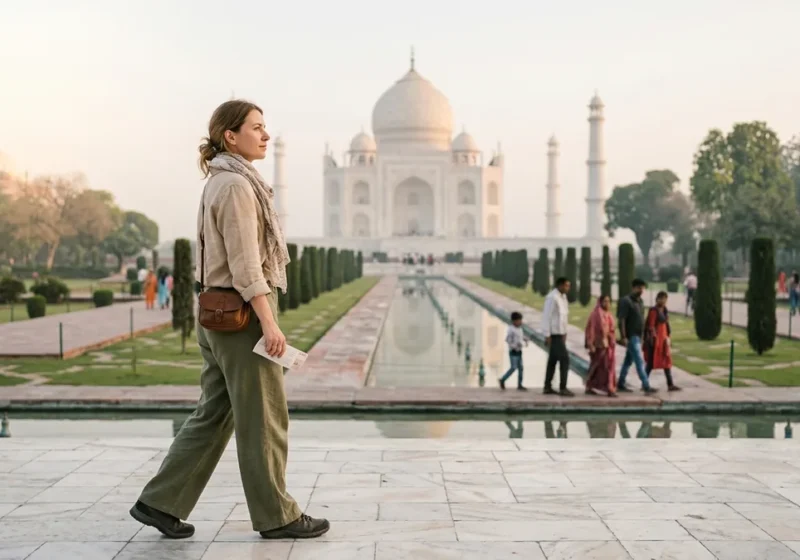
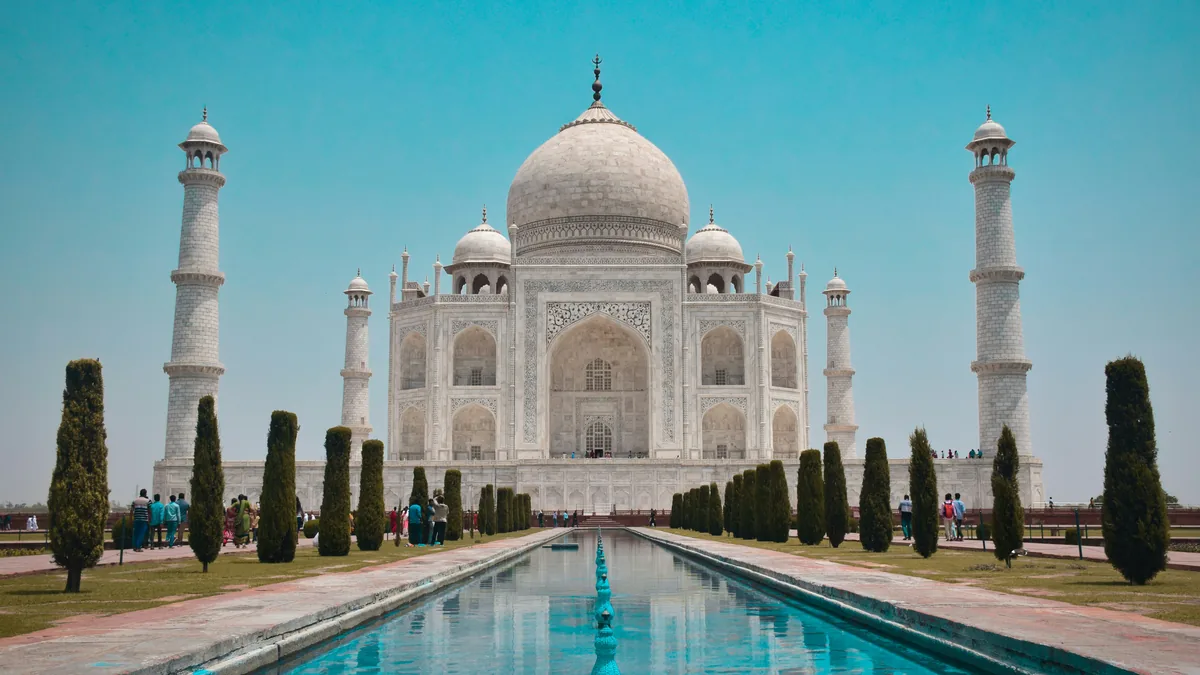
The Taj Mahal was built by the Mughal emperor Shah Jahan in memory of his wife Mumtaz Mahal. The mausoleum went up between 1632 and 1648, the rest of the complex was finished by 1653, and it became a UNESCO World Heritage Site in 1983.
It looks better in person than in photographs. The marble changes colour through the day: pinkish at dawn, white at noon, golden in the late afternoon.
Sunrise, almost always. The gates open 30 minutes before sunrise, the air is cool and the first hour is the quietest of the day. By 10 a.m. in high season the queues and the crowds are heavy.
The ideal plan is to arrive in Agra the afternoon before, see Agra Fort and the sunset from Mehtab Bagh, sleep in Agra, and be at the Taj gate at first light. That’s why a same-day trip from Delhi, although possible, is a compromise. Our Delhi to Agra same-day trip guide explains how to make one work.
Read the UNESCO listing for the Taj Mahal before you go; it makes the visit richer.
Agra has far more than one building. With a night in the city you can add these:
| Place | Why go | Time needed |
|---|---|---|
| Agra Fort | The red sandstone Mughal fort where Shah Jahan was imprisoned, looking out at the Taj. Open every day | 1.5–2 hours |
| Mehtab Bagh | Riverside garden directly across the Yamuna from the Taj; the classic sunset view | 45 minutes |
| Itimad-ud-Daulah (the ‘Baby Taj’) | Delicate white-marble tomb with inlay work that came before the Taj | 45 minutes |
| Akbar’s Tomb, Sikandra | Grand tomb of the greatest Mughal emperor, with deer in the gardens | 1 hour |
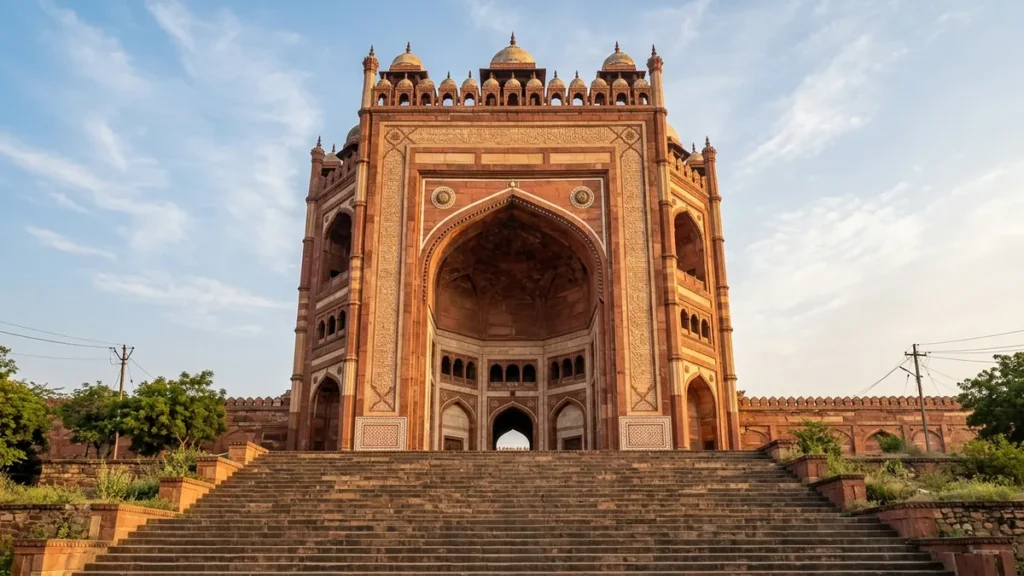
| Fatehpur Sikri | Akbar’s abandoned red sandstone capital, 40 km west, on the road to Jaipur | 2–2.5 hours |
Fatehpur Sikri is the one not to skip. Akbar built it from 1571 as his new capital, and it served as the Mughal seat of power for only about ten years before the court moved on in 1585. The great gateway, the Buland Darwaza, was finished in 1575 to mark his victory in Gujarat.
Foreigners pay ₹600 at the counter or ₹550 online at Fatehpur Sikri (see the UNESCO page for Fatehpur Sikri for the history). Because it lies on the Jaipur road, it costs you almost no extra driving on a clockwise golden triangle tour.
Agra is also where the hard sell is strongest. On a private golden triangle tour, no one should take you shopping unless you ask. Our drivers don’t.
Entry tickets are paid on the day and aren’t included in any car-and-driver price. These are the foreigner rates we’ve checked for the 2026–27 season:
| Monument | Foreign visitor fee | Notes |
|---|---|---|
| Taj Mahal | ₹1,100 + ₹200 for the main tomb | Closed Fridays |
| Agra Fort | ₹650 | Open daily |
| Fatehpur Sikri | ₹600 (₹550 online) | 40 km from Agra |
| Mehtab Bagh | ₹300 | Sunset view of the Taj |
| Humayun’s Tomb | ₹600 (₹550 online) | Open daily |
| Qutub Minar | ₹600 (₹550 online) | Open daily |
| Red Fort | ₹600 (₹550 online) | Closed Mondays |
| Amber (Amer) Fort, Jaipur | ₹1,000 | Raised from ₹500 on 1 January 2026 |
| Hawa Mahal, Jantar Mantar, Albert Hall, Nahargarh | ₹600 each | Also raised in January 2026 |
| Jaipur state composite ticket | About ₹1,700 | One entry to Amber, Hawa Mahal, Jantar Mantar, Nahargarh, Albert Hall and more |
| City Palace, Jaipur | About ₹1,200 | Privately run; separate ticket |
Budget roughly ₹7,000 to ₹8,500 per adult (about USD 85–100) for entry fees on a full golden triangle tour that includes the Taj mausoleum, Agra Fort, Fatehpur Sikri, two or three Delhi monuments, the Jaipur composite ticket and the City Palace. Children under 15 go free at the ASI monuments.
The Jaipur rise matters. Rajasthan’s archaeology department raised its fees from 1 January 2026, and Amber Fort doubled for foreigners. If you’ll see three or more of the state-run Jaipur sites, the composite ticket now saves money.
Jaipur was founded in 1727 by Maharaja Sawai Jai Singh II and laid out on a grid, which was unusual for its time. The walled city was added to the UNESCO list in 2019. Its buildings were painted pink in 1876 to welcome the Prince of Wales, and the colour stuck.
It’s the most colourful stop on any golden triangle tour: a hilltop fort, a royal palace, an 18th-century observatory, and bazaars full of block prints and blue pottery.
One day is enough for the headline sights. Two days means you can see Amber Fort early before the tour buses, take the afternoon off, and spend the evening at Nahargarh Fort watching the sun go down over the city.
Here’s how we’d order a Jaipur day, and why:
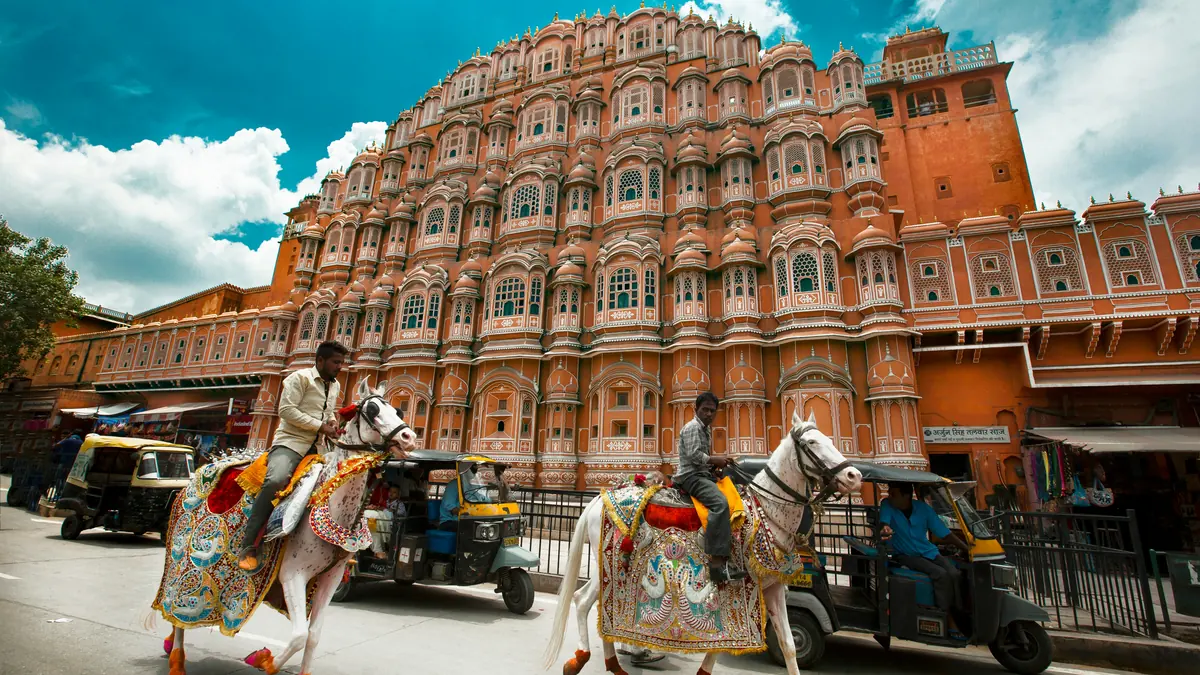
Amber Fort and its neighbours are part of the Hill Forts of Rajasthan World Heritage Site. The City Palace is privately run and sets its own prices; it’s open from 9:30 a.m. to 6:30 p.m. (see the City Palace visitor page).
A licensed local guide transforms Amber Fort and the City Palace. Our drivers aren’t licensed to guide inside monuments, but we can book an approved guide for you. Read guide or driver: who you need for how that works.
A golden triangle tour is a natural base for bigger trips. These are the extensions our guests choose most often:
| Add-on | How it fits | Extra days |
|---|---|---|
| Ranthambore (tigers) | About 160 km from Jaipur. Safari season runs 1 October to 30 June | +2 |
| Varanasi (the Ganges) | Fly from Delhi, about 1.5 hours; or train | +2–3 |
| Khajuraho (temples) | Vande Bharat train from Agra, or drive | +2 |
| Udaipur (lakes and palaces) | About 400 km from Jaipur, 6–7 hours; or fly | +3 |
| Pushkar (holy lake town) | About 145 km from Jaipur | +1–2 |
| Amritsar (Golden Temple) | Fly from Delhi, about 1 hour 15 minutes | +2 |
Ranthambore is the easiest add-on: it slots between Agra and Jaipur or after Jaipur, and two safaris give you a real chance of seeing a tiger. Our Golden Triangle with Ranthambore guide covers zones, permits and timings.
Varanasi and Khajuraho turn the loop into a deeper look at Hindu India. The Hazrat Nizamuddin–Khajuraho Vande Bharat train stops at Agra and runs six days a week, which makes Agra to Khajuraho easy. See our Rajasthan itinerary guide if you’d rather add Udaipur and Jodhpur, or our Amritsar travel guide for the Golden Temple.
There are three ways to do the loop. Here’s how they compare:
| Private car and driver | Train | Group coach tour | |
|---|---|---|---|
| Door to door | Yes | No; stations at each end | Hotel pick-up, fixed times |
| Fatehpur Sikri and Abhaneri | Easy stops on the way | Not practical | Sometimes included |
| Flexibility | Full: your pace, your stops | Fixed timetable | None |
| Shopping stops | Only if you ask | None | Often several |
| Cost for 2 people | Moderate | Cheapest | Cheap to moderate |
| Best for | Most travellers, families, anyone 4+ | Solo budget travellers | Those who want company |
The train works well for Delhi to Agra: the Gatimaan Express does it in about 100 minutes and doesn’t run on Fridays, which is no loss because the Taj is closed then. The Agra–Jaipur leg is less convenient by rail, and you still need taxis at each end.
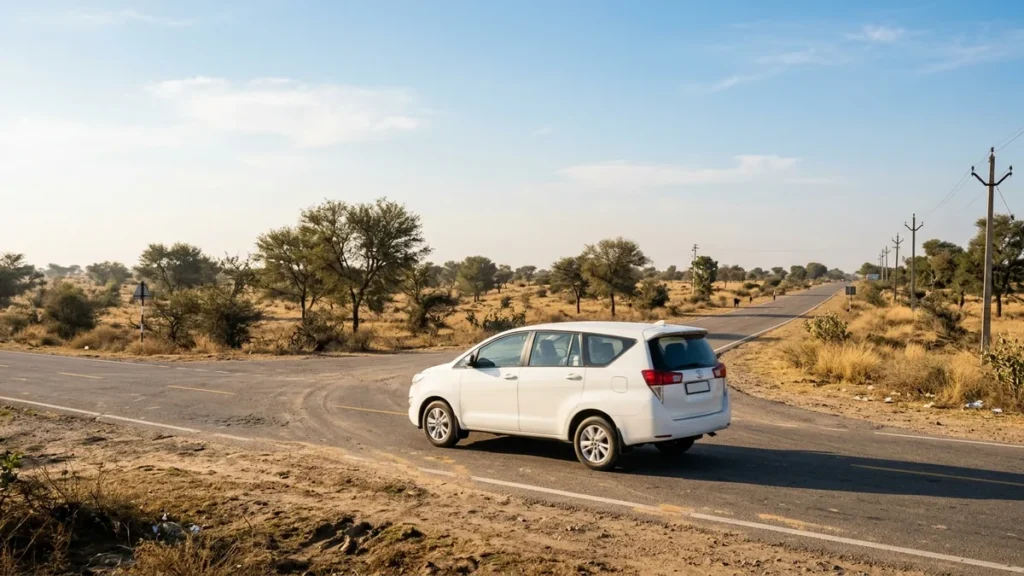
A private car is what we recommend, and not only because it’s what we do. For two people the cost difference over the train is modest, and for three or more a car is often cheaper. You leave when you want, stop at Fatehpur Sikri or a roadside dhaba, and your luggage stays in the boot.
A new airport: Noida International Airport at Jewar, on the Yamuna Expressway, began commercial flights on 15 June 2026. Most international visitors will still land at Delhi’s main airport, and a golden triangle tour can start from either.
Every golden triangle tour we run is private: just your group, your own car and your own driver. Prices are for the whole vehicle, not per person, so the more of you there are, the cheaper it gets per head.
| Trip | Sedan (1–3) | SUV (4–5) | Tempo Traveller (6–8) |
|---|---|---|---|
| Same-day Taj Mahal tour from Delhi | USD 113 | USD 154 | USD 202 |
| Circuit Triangle d’or 4 jours | USD 356 | USD 488 | USD 640 |
| Circuit Triangle d’or 6 jours | USD 534 | USD 732 | USD 960 |
| Classic Golden Triangle Tour, 7 days | USD 623 | USD 854 | USD 1,120 |
| Luxury Private Golden Triangle, 7 days | USD 623 | USD 854 | USD 1,120 |
| Golden Triangle with Ranthambore, 7 days | USD 623 | USD 854 | USD 1,120 |
| Golden Triangle with Ranthambore Tiger Safari, 8 days | USD 712 | USD 976 | USD 1,280 |
| Golden Triangle, Khajuraho and Varanasi, 10 days | USD 890 | USD 1,220 | USD 1,600 |
So a couple on our 6-day golden triangle tour pays USD 534 in total for transport, or USD 267 each, plus hotels and roughly USD 85–100 each in entry fees. That’s the real golden triangle tour cost. For how Indian car hire is usually priced, see car and driver costs in India, and for our day rates see private car and driver in India.
Tell us your dates, how many of you are travelling and what you’d like to see. We reply within 24 hours with a fixed price for the car and driver. If you’d like a detailed day-by-day itinerary, it costs €100, and the full €100 is deducted from your tour price when you book. There is no obligation.
Sur mesure en Inde & au Népal
Dites-nous ce que vous aimez et nous répondons sous 24 heures avec un prix fixe. Un itinéraire détaillé jour par jour coûte €100, entièrement déduits du prix du circuit.
Choisissez une ou plusieurs destinations — vous pouvez combiner librement l’Inde et le Népal.
Cela nous aide à trouver le bon rythme, les bons hébergements et les bonnes activités.
Nous répondons sous 24 heures. Jamais de spam.
Before you book anything, run through these eight questions:
If you can answer yes to most of these, your golden triangle tour is in good shape.
Think of the golden triangle tour as three different stories. Delhi is the capital of empires, from the Sultanate to the Raj. Agra is the Mughal high point, with the Taj Mahal at its heart. Jaipur is Rajput Rajasthan: forts, palaces and colour.
Give each story enough time. Get the days of the week right, travel in the cool season, and let a good driver handle the roads between them.
Do that, and a golden triangle tour is one of the easiest and most rewarding trips in Asia.
It’s a circuit of Delhi, Agra and Jaipur, three cities that form a rough triangle on the map in north India. The loop is about 750 km and includes seven UNESCO World Heritage Sites, among them the Taj Mahal, Agra Fort, Fatehpur Sikri, Humayun’s Tomb and Amber Fort.
Five to six days is ideal for a first visit. Four days is the realistic minimum, with one full day in each city. Three days is possible but rushed, and seven or eight days leaves room for Ranthambore or a slow second day in Jaipur.
Mid-October to mid-March, with November and February usually the best. April to June is very hot, often above 40 °C, and July to September is the monsoon. Late December and January can bring early-morning fog.
The Taj Mahal is closed every Friday, when it opens only for prayers at the mosque. On other days it opens 30 minutes before sunrise and closes 30 minutes before sunset. Plan your Agra day so it isn’t a Friday.
₹1,100 for foreign nationals, plus ₹200 if you want to go inside the main mausoleum. SAARC and BIMSTEC nationals pay ₹540, Indians ₹50, and children under 15 are free. Booking online on the ASI site gives a small discount.
Most tours go Delhi, Agra, Jaipur and back to Delhi, because Fatehpur Sikri and the Abhaneri stepwell lie on the Agra to Jaipur road. Reversing the loop is fine and can help avoid landing in Agra on a Friday.
Delhi to Agra is about 230 km, or 3 to 4 hours on the Yamuna Expressway. Agra to Jaipur is about 240 km and 4 to 5 hours. Jaipur to Delhi is about 280 km and 4 to 6 hours, depending on route and Delhi traffic.
With us, a private 6-day tour costs USD 534 for a sedan (1 to 3 travellers), USD 732 for an SUV (4 to 5) and USD 960 for a Tempo Traveller (6 to 8). That’s for the whole vehicle, including fuel, tolls, parking, taxes and the driver. Hotels, meals and entry fees are extra.
No. Our prices cover the car, driver, fuel, tolls, parking and state taxes. Entry tickets are paid at each monument and come to roughly ₹7,000 to ₹8,500 per adult for a full loop, or about USD 85 to 100.
Yes. From 1 January 2026 Amber Fort rose to ₹1,000 for foreigners, and Hawa Mahal, Jantar Mantar, Albert Hall and Nahargarh to ₹600 each. A state composite ticket of about ₹1,700 covers one entry to each and now saves money if you visit three or more.
The train is good for Delhi to Agra; the Gatimaan Express takes about 100 minutes and doesn’t run on Fridays. For the whole loop a private car is easier, because it’s door to door and lets you stop at Fatehpur Sikri and Abhaneri on the way to Jaipur.
Sunrise is best: the gates open 30 minutes before sunrise, the light is soft and the crowds are smallest. For sunset, view it from Mehtab Bagh across the river, which costs ₹300 for foreigners and is open on Fridays.
The most popular add-ons are Ranthambore for tigers (about 160 km from Jaipur), Varanasi and Khajuraho, Udaipur (about 400 km from Jaipur), Pushkar and Amritsar. Each adds two or three days. Our 8-day Ranthambore tour costs USD 712 for a sedan.
Our drivers aren’t licensed to guide inside monuments. A licensed local guide is worth it at the Taj Mahal, Agra Fort, Fatehpur Sikri, Amber Fort and the City Palace, and we can book approved guides on request.
Yes. It’s written for the October 2026 to June 2027 season, with the January 2026 Jaipur fee changes and the new Noida airport included. Fees and timings do change, so check them again just before you travel.
A good golden triangle tour isn’t about seeing the most monuments. It’s about seeing the right ones at the right time of day.
Is Agra on a day other than Friday? Is the Taj at sunrise? Does Jaipur get a full day? Is Fatehpur Sikri on the way? Are you travelling in the cool months?
If the answer is yes, you’ll have an easy, memorable trip. If not, you’ll spend it in queues and traffic.
Once you plan around those points, the golden triangle tour becomes simple. For day-by-day detail, read our 4-day plan, our 6-day plan or our guide to choosing the right golden triangle itinerary.
See the 6-day Golden Triangle tour · Car and driver rates in India · Plan my trip