By the Khadaka Family · GoIndiaNepal (formerly The Pearls of India) · Planning Rajasthan tours since 1996
Rajasthan is India’s most photographed state. Every travel blog, every Pinterest board, every Instagram reel has covered the Pink City, the Blue City, the camels, and the palaces. But almost none of them are written by people who have actually been arranging these journeys for three decades.
We have. Since 1996, our family has guided travelers from over 40 countries through every corner of Rajasthan — from honeymooners booking lakeside palaces in Udaipur to photographers chasing the perfect golden hour at Jaisalmer Fort. This guide is what we’ve learned: the routes that work, the cities that disappoint when you visit them wrong, the moments that turn a good Rajasthan Tour into one you’ll talk about for the rest of your life.
If you only have a few minutes, skip to the section that fits you:
A Rajasthan Tour is a multi-city journey through India’s largest state — roughly the size of France — built around its color-coded heritage cities, sandstone forts, royal palaces, and desert landscapes.
Most Rajasthan Tours include some combination of:
A complete Rajasthan Tour takes 10-18 days. We design every itinerary around what matters most to you — speed, comfort, budget, photography, food, or quiet immersion.
The best time to book a Rajasthan Tour is between November and March. During these months, you get:
The sweet spot within this window is mid-November through mid-February. November means peak Pushkar Camel Fair season. January brings the Jaipur Literature Festival, the world’s largest free literary event. February gives you the Desert Festival in Jaisalmer.
Every hotel we use on a Rajasthan Tour has air conditioning, even our budget options. The heat is real but never an emergency when you have a cool room to return to. Pack a sun hat and high-SPF sunscreen regardless of season — afternoons are warm even in December.
Every Rajasthan Tour guide on the internet describes these four cities. Here is what we tell our clients honestly, after 30 years of watching travelers love or merely tolerate each one.
Painted pink in 1876 to welcome the Prince of Wales, Jaipur is the capital of Rajasthan and the gateway to almost every Rajasthan Tour. It is also the city most likely to disappoint travelers who arrive expecting Instagram and meet honking traffic instead.
The truth about Jaipur. The Pink City is real, but it is concentrated in the walled old city — not the modern outskirts where most hotels sit. To experience Jaipur properly, you must enter the old city on foot, ideally early morning before the heat and traffic build up.
Must-see attractions:
Our insider tip. Buy the composite ticket (about ₹300). It covers Amber Fort, Hawa Mahal, Jantar Mantar, and several other sites. Buying individual tickets at each location costs roughly double.
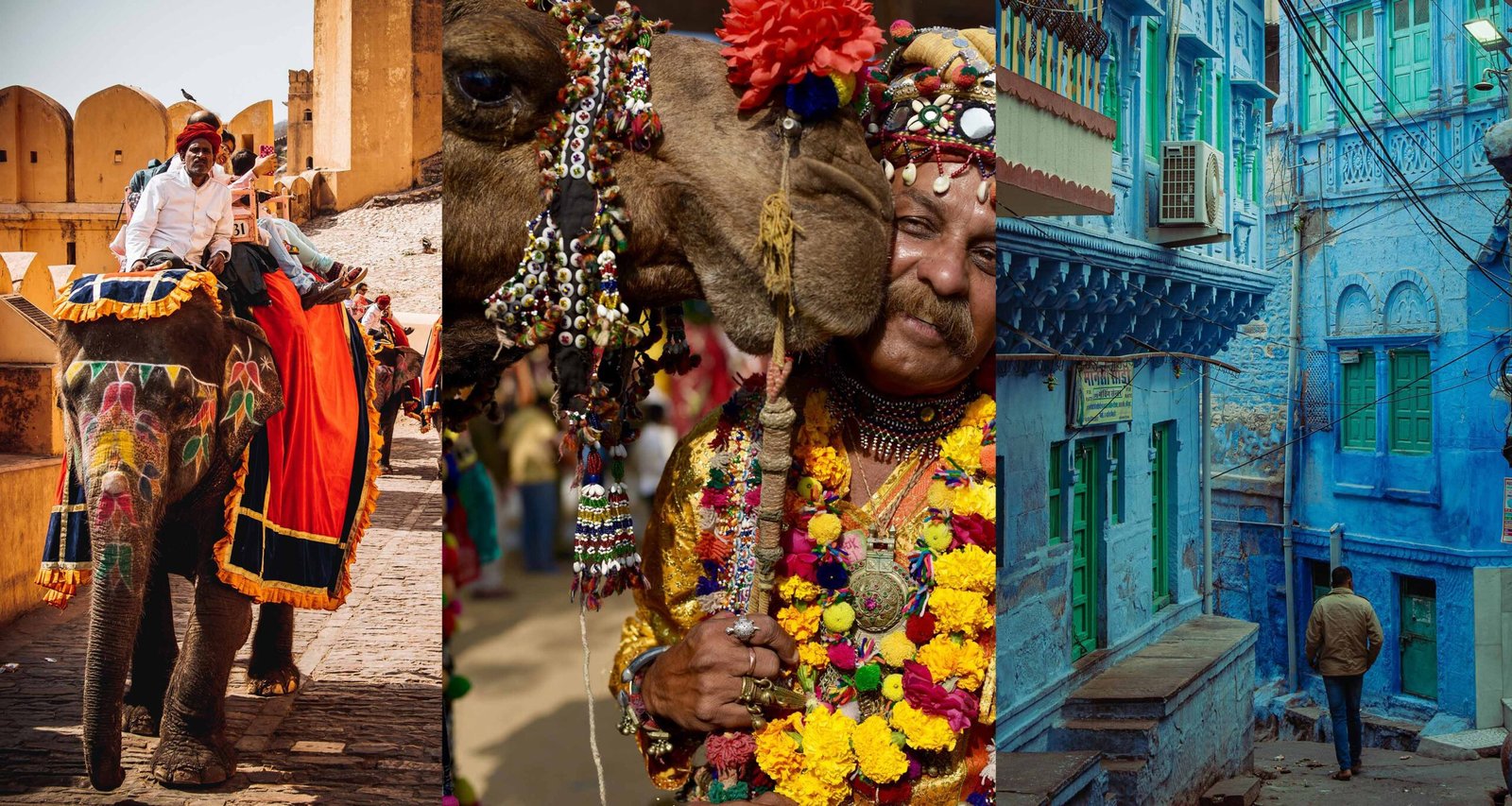
Founded by Rajput chief Rao Jodha, Jodhpur is dominated by Mehrangarh Fort — one of India’s largest and best-preserved forts, perched on a rocky hill 122 meters above the city. Below it, the old Brahmin quarter is painted in shades of indigo blue, creating the maze of lanes that makes Jodhpur famous.
Why we love it. Mehrangarh feels less crowded than Amber Fort. The blue lanes are walkable, photogenic, and full of small shops selling textiles and silver at fair prices.
Must-see attractions:
Our insider tip. Skip the expensive rooftop restaurants that charge premium prices for a fort view. Hike up Pachetia Hill near the stepwell instead. The 360-degree view of the blue city and Mehrangarh is identical, and it costs nothing.
Often called “the Venice of the East” or “the City of Lakes,” Udaipur is widely considered India’s most romantic city. Set around Lake Pichola with the Aravalli Hills in the distance, its white marble palaces appear to float on the water.
Why honeymooners love it. Udaipur is calmer than Jaipur, more picturesque than Jodhpur, and offers Rajasthan’s two most iconic palace hotels: the Lake Palace and the Oberoi Udaivilas. Even if you don’t stay at either, you can dine there.
Must-see attractions:
Our insider tip. Don’t pay extra for a “lake view” hotel unless you can afford a true lakeside palace. The public Gangaur Ghat offers exactly the same view, and you can sit there for free.
Rising from the heart of the Thar Desert, Jaisalmer is famous for its yellow sandstone architecture that glows like gold in the sunlight. Unlike other forts that feel like museums, Jaisalmer Fort is a “living fort” — about 3,000 people still live inside it.
Why we love it. The fort is free to enter. You can wander narrow lanes, visit ancient Jain temples, and find panoramic viewpoints without paying a rupee. The desert safari that follows is the most surreal experience on most Rajasthan Tours.
Must-see attractions:
Our insider tip. Avoid the cheapest desert safari packages. The competition has driven prices so low that some operators cut corners on food, camp quality, and animal welfare. Pay a little more for a reputable operator (we vet ours carefully).
The four color-coded cities draw the crowds, but some of Rajasthan’s most meaningful experiences lie beyond them. If you have 14+ days, add these.
Steeped in mysticism and surrounded by desert, Pushkar is a Hindu pilgrimage town centered on the sacred Pushkar Lake. It is surrounded by more than 500 temples and home to one of the only Brahma temples in the world.
Plan around the Pushkar Camel Fair (November each year), one of India’s most spectacular events. Thousands of camels, horses, and cattle are traded, accompanied by competitions, cultural performances, hot-air balloons, and night markets. Book hotels four months in advance.
Tucked into the Aravalli foothills, Bundi is a quiet, photogenic town known for its palace, painted miniatures, and indigo-washed houses. It is less developed than Udaipur, which is exactly why we recommend it.
The 15th-century Jain temples at Ranakpur are architectural masterpieces. The main temple, carved from white marble, features 29 halls supported by 1,444 pillars, no two carved alike. We always include Ranakpur on the drive between Jodhpur and Udaipur.
Near Jodhpur, a jeep safari through Bishnoi villages offers a window into traditional desert life. You will meet farmers, herders, and silversmiths, and see the Bishnoi community’s remarkable commitment to wildlife conservation — a tradition stretching back five centuries.
Rajasthan’s festival calendar is one reason this state outranks every other Indian destination for cultural travelers. Plan your Rajasthan Tour around these dates whenever possible.
| Festival | Dates (2026) | Location | Why it matters |
|---|---|---|---|
| Bikaner Camel Festival | January 10-11 | Bikaner | Camel races, camel dances, decorated processions |
| Kite Festival | January 14 | Jaipur (statewide) | Skies filled with colored kites; evening fireworks |
| Nagaur Fair | January 24-27 | Nagaur | India’s second-largest cattle fair |
| Jaipur Literature Festival | February 1-5 | Jaipur | The world’s largest free literary festival |
| Desert Festival | February 9-11 | Jaisalmer | Folk music, puppet shows, turban competitions |
| Udaipur World Music Festival | February 9-11 | Udaipur | Global artists across multiple lakeside venues |
| Holi (Dhulandi) | March 3 | Jaipur, Pushkar | The festival of colors |
| Elephant Festival | March 2 | Jaipur | Painted elephants, polo, and processions |
| Gangaur Festival | March 21-23 | Jaipur, Udaipur | Processions of goddess idols, folk performances |
| Mewar Festival | March 21-23 | Udaipur | Welcoming spring with cultural events on Lake Pichola |
A note on Holi. Many travelers want to experience Holi in Rajasthan. We offer special departures that include traditional white kurta outfits and safe, organized celebrations. Holi can be intense for first-time visitors; doing it with a local guide makes it joyful instead of overwhelming.
This is the most-booked Rajasthan Tour structure for first-time visitors. It balances depth and movement without exhausting anyone.
| Day | Destination | Highlights |
|---|---|---|
| 1-2 | Delhi | Arrival, Old & New Delhi sightseeing |
| 3 | Agra | Taj Mahal at sunrise, Agra Fort |
| 4 | Jaipur | En route: Fatehpur Sikri, then evening arrival in Jaipur |
| 5-6 | Jaipur | Amber Fort, City Palace, Jantar Mantar, bazaars |
| 7-8 | Jodhpur | Mehrangarh Fort, Jaswant Thada, blue city walk |
| 9 | Ranakpur | Marble Jain temples en route to Udaipur |
| 10-11 | Udaipur | City Palace, Lake Pichola boat ride, Jagdish Temple |
| 12 | Departure | Fly from Udaipur, or drive back to Delhi |
For travelers who want the complete Rajasthan experience, including Jaisalmer and rural villages.
| Days | Destination | Highlights |
|---|---|---|
| 1-6 | Delhi, Agra, Jaipur | As above |
| 7 | Pushkar | Drive via Ajmer, evening at Pushkar Lake |
| 8 | Pushkar to Jodhpur | Morning sightseeing, afternoon drive |
| 9 | Jodhpur | Mehrangarh Fort, blue city |
| 10 | Bishnoi villages & drive to Jaisalmer | Jeep safari through traditional villages |
| 11-12 | Jaisalmer | Fort, desert safari with camel ride, cultural night |
| 13 | Drive to Udaipur via Ranakpur | Marble Jain temples |
| 14 | Udaipur | City Palace, boat ride |
| 15 | Departure |
Combining Rajasthan with Nepal is one of the smartest decisions you can make if you have the time. Two countries, one trip, dramatically lower per-day cost than two separate journeys.
| Days | Destination | Highlights |
|---|---|---|
| 1-12 | Full Rajasthan circuit | As 12-day itinerary above |
| 13 | Fly Delhi to Kathmandu | |
| 14-15 | Kathmandu Valley | Pashupatinath, Boudhanath, Bhaktapur |
| 16-17 | Pokhara | Himalayan views, Phewa Lake |
| 18 | Departure from Kathmandu |
For luxury travelers and honeymooners, the most memorable part of a Rajasthan Tour is often the accommodation. We arrange stays at India’s most iconic heritage properties — palaces converted into hotels where the descendants of original royal families still live.
Worth considering:
We can also arrange experiences that don’t appear on standard booking sites: private dinners on lake islands, falconry sessions in the desert, sunrise hot-air balloon flights over Pushkar, sitar concerts at sunset, and cooking classes with former palace chefs.
A great Rajasthan Tour does not require a luxury budget. We design budget-friendly versions of every itinerary above. Here is what genuinely works.
A 12-day budget Rajasthan Tour can be done comfortably for around $400-600 per person. We never refuse a budget traveler.
Things we’ve learned from hosting thousands of Rajasthan Tours.
ATMs are everywhere in cities. UPI digital payment is widely accepted but does not yet work with foreign banking apps. Carry small denominations for tips, temple donations, and rural purchases. Hotels and large restaurants accept cards; markets and auto-rickshaws do not.
Indian SIM cards are difficult for foreign visitors to activate quickly. Either buy an international roaming package before you arrive, or use Airalo eSIM (works instantly with most modern phones). Wi-Fi at hotels is generally good in cities, patchy in deserts.
Modest dress is appreciated everywhere and required at religious sites. Pack breathable cotton or linen. Bring a large scarf or pashmina — useful for covering shoulders at temples, sitting on stone floors, and as a layer for cool desert evenings.
Drink bottled or filtered water for the first three days while your stomach acclimates. Eat at busy restaurants with high turnover. Stick to cooked food rather than raw salads at small vendors. Beyond that, eat adventurously — the food in Rajasthan is some of the most distinctive in India.
Always ask before photographing people, especially women and the elderly. Many sites restrict photography inside sanctums. Respect signs and ask if unsure. Tip people ₹50-100 if you photograph them at length — it is appreciated.
After three decades, these are the mistakes we see most often.
1. Trying to cover too many cities in too few days. A relaxed 12-day Rajasthan Tour beats an exhausted 9-day version. You traveled across the world. Don’t spend it in transit.
2. Skipping Jaisalmer. Some travelers cut Jaisalmer because of the long drive. Don’t. The desert and the living fort are unforgettable. Take the overnight train if road travel feels too long.
3. Choosing the cheapest desert safari operator. Some safari operators cut corners dangerously — poor food, dirty bedding, mistreated camels. Pay a little more and use a reputable operator. We vet ours carefully.
4. Booking heritage hotels last minute. The best heritage properties book out 4-6 months in advance, especially during festival weeks. Plan early or accept second-tier options.
5. Eating only at hotel restaurants. The best food in Rajasthan is in local restaurants and street stalls, not five-star buffets. Be brave with cooked street food at popular stalls.
6. Not allowing rest days. Rajasthan is intense — heat, crowds, sensory overload. Plan one rest day every 5-6 days. The travelers who skip rest days are the ones who get sick by day 9.
7. Booking with the cheapest operator on Google. A Rajasthan Tour involves long drives, complex logistics, monument fees, and hotel coordination across multiple cities. A bad operator can ruin a once-in-a-lifetime trip. References, reviews, and operator history matter more than price.
We are a family-run operator, not a corporate booking platform. Khem “Babu” Khadaka, our founder, has been planning Rajasthan Tours since 1996. His philosophy hasn’t changed in 30 years:
“If you’re happy, I am happy.”
What that means in practice:
We have planned Rajasthan Tours for honeymooners from Italy, photographers from Japan, retired couples from Australia, multi-generation family groups from California, and solo backpackers from South America. Every traveler is different. Every itinerary should be too.
There’s no obligation. Send us a message — by WhatsApp, email, or our Plan My Dream Trip form — with your dates, group size, and what kind of experience you’re hoping for. We’ll send back a detailed, personalized itinerary within 24 hours.
📱 WhatsApp: +91 98109 09368 ✉️ Email: [email protected] 🏠 Office: Sarita Vihar, New Delhi, India
Namaste, and we hope to be the family planning your Rajasthan Tour in 2026.
— The Khadaka Family GoIndiaNepal (formerly The Pearls of India) Serving travelers since 1996
Q: How many days do I need for a Rajasthan Tour? The minimum is 8-9 days for a focused circuit (Jaipur, Jodhpur, Udaipur). We recommend 12-15 days to include Jaisalmer’s desert and rural villages. Add 5-7 days for a Nepal extension.
Q: What’s the best month for a Rajasthan Tour in 2026? November through February. The Pushkar Camel Fair (November), Jaipur Literature Festival (February), and Desert Festival (February) make these months especially rewarding.
Q: Is Rajasthan safe for solo female travelers? Yes, when planned by a reputable operator. We’ve guided hundreds of solo female travelers across Rajasthan without incident. We can also arrange female drivers and guides on request.
Q: Can I combine a Rajasthan Tour with the Golden Triangle? Yes. In fact, most of our 12-15 day itineraries include the Golden Triangle (Delhi, Agra, Jaipur) as the first leg, with the rest of Rajasthan following.
Q: How much does a Rajasthan Tour cost in 2026?
We quote based on your actual preferences, not fixed packages.
Q: Do I need a visa to visit Rajasthan? Most travelers from the US, UK, EU, Australia, and Canada are eligible for India’s e-Tourist Visa, processed in 3-5 days online. We assist with the process if needed.
Q: Can I see all four color cities in one trip? Yes, with 12-15 days. The 15-Day Grand Rajasthan Tour above covers Jaipur, Jodhpur, Udaipur, and Jaisalmer with a desert safari and rural village experiences.