By the Khadaka Family · GoIndiaNepal (formerly The Pearls of India) · Serving pilgrims and seekers since 1996
Why 2026 Is a Once-in-a-Generation Year for Pilgrimage
For nearly 30 years, our family has guided travelers through the sacred geography of India and Nepal. We have walked with Hindu pilgrims to Pashupatinath, sat with Buddhist monks at Bodh Gaya, and helped Sikh families trace the footsteps of Guru Nanak Dev Ji. In all those years, no single moment has felt as important as 2026.
The Ram Mandir in Ayodhya is finally open to the public. Varanasi has unveiled the world’s largest meditation temple. New stupas are rising in Vaishali. Roads that once took 12 hours of bone-rattling travel now take 6. The Nepal Tourism Board has built dedicated spiritual circuits connecting all of South Asia’s holiest sites.
This is not a hype piece. This is a guide for anyone planning an India Nepal Pilgrimage Tour in 2026, written by people who do this for a living and care about getting it right.
If you only have a few minutes, skip ahead to the section that matches you:
- Devout pilgrim with specific sites in mind? Start with The Four New Sacred Sites You Cannot Miss.
- Yoga, meditation, or wellness seeker? Head to Wellness Retreats Where Ancient Wisdom Meets Modern Science.
- Cultural traveler curious about the spiritual journey? Begin with Sample 14-Day Pilgrimage Itinerary.
What Is an India Nepal Pilgrimage Tour?
An India Nepal Pilgrimage Tour is a structured spiritual journey that connects the sacred sites of two countries into a single, transformative trip. Unlike standard tourism, a pilgrimage tour is built around devotion, reflection, and meaning, not photo opportunities.
Most India Nepal Pilgrimage Tours include some combination of:
- Hindu holy cities like Varanasi, Haridwar, Rishikesh, and Ayodhya
- Buddhist sacred sites like Bodh Gaya, Sarnath, Lumbini, and Kushinagar
- Sikh heritage sites along the path Guru Nanak Dev Ji once traveled
- Mountain temples and meditation retreats in the Himalayan foothills
- Wellness experiences rooted in Ayurveda, yoga, and ancient Vedic practice
The two countries share a 1,800-kilometer open border. For travelers, this means one well-planned trip can carry you from the burning ghats of Varanasi to the birthplace of Buddha in Lumbini, from Hindu Shiva temples to Tibetan Buddhist monasteries, without complicated logistics.
The Four New Sacred Sites You Cannot Miss
The spiritual landscape of India and Nepal has changed more in the last three years than in the previous three decades. Four new sites genuinely belong on every 2026 itinerary.
1. Ram Mandir, Ayodhya
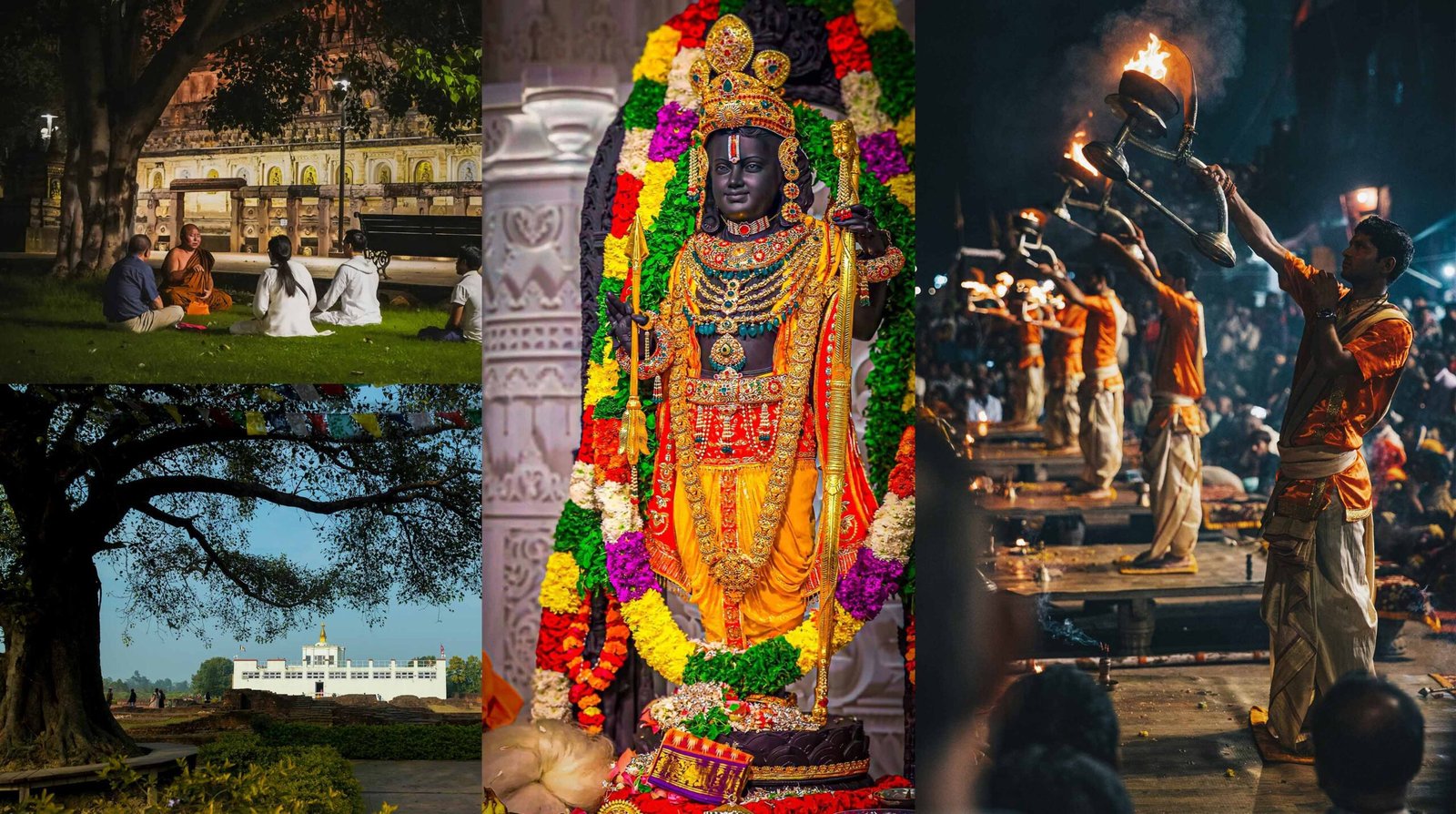
The Ram Mandir is now fully complete and open to devotees. Built entirely from pink sandstone, it stands as the most significant Hindu architectural achievement in modern history. For Hindus, this is the spiritual event of a generation.
What to know before you go. Security is exceptionally strict. Allow at least two hours for entry, including baggage deposit and identity checks. Photography is restricted inside the main sanctum. Dress conservatively, with shoulders and knees covered. The best months to visit are October through March, when the climate is gentle and crowds, while large, are manageable.
Our honest advice. Go on a weekday morning if at all possible. Weekends can mean 4-6 hour wait times. We arrange early-access slots through trusted contacts for our clients on India Nepal Pilgrimage Tours, which can reduce waiting to about 90 minutes.
2. Svarved Mahamandir, Varanasi
Located in the Umaraha area, about 40 minutes from central Varanasi, Svarved Mahamandir is now the world’s largest meditation temple. Seven stories tall, it can hold 20,000 people at once. The sandstone carvings inside depict verses from the Svarved, an ancient text rarely seen outside scholarly circles.
This is one of the few places in India where you can meditate without distraction. Even at peak hours, the temple’s scale absorbs the noise. Travelers consistently describe it as one of the most moving stops on their pilgrimage.
Pair it with. A sunrise boat ride on the Ganges, followed by Svarved Mahamandir in the late morning, makes for the most powerful single day in Varanasi.
3. Buddha Samyak Darshan Stupa, Vaishali
Vaishali is one of the most historically significant cities in Buddhism, where the Buddha is said to have given his final teaching before passing on. Until recently, what remained were brick ruins and faded memory. The new Buddha Samyak Darshan Stupa changes that. Built to enshrine relics of the Buddha (including those of a Lichchavi king), it gives Vaishali the major Buddhist landmark it has deserved for centuries.
For Buddhist pilgrims, this site now completes the four-stupa circuit (Lumbini, Bodh Gaya, Sarnath, Kushinagar) with a fifth essential stop.
4. Ramagrama Stupa, Nepal
If you appreciate raw, unspoiled spiritual sites, visit Ramagrama Stupa before 2027. It is the only major Buddhist stupa in the world that has never been excavated. Local legends say it is protected by serpent spirits called Nagas, and out of respect for those legends, archaeologists have honored the request to leave it untouched.
International architects are now planning a major development project in the surrounding area. The stupa itself will not be disturbed, but the atmosphere of quiet, unmanaged sacredness around it will change forever. Travelers who visit now describe the experience as the most authentic moment of their entire India Nepal Pilgrimage Tour.
Sacred Circuits: Which One Is Right for You?
Not every pilgrim wants the same journey. We design India Nepal Pilgrimage Tours around four main circuits, and most travelers combine elements from two or three.
The Hindu Circuit
A traditional Hindu pilgrimage focuses on Varanasi, Haridwar, Rishikesh, Ayodhya, and Pashupatinath in Kathmandu. The route honors the great river deities (Ganga and Yamuna), Lord Shiva, and Lord Ram. A 10-12 day itinerary covers the essentials. Add Mathura and Vrindavan for those drawn to Lord Krishna.
The Buddhist Circuit
The classical Buddhist pilgrimage covers the four sites associated with the Buddha’s life: Lumbini (birth), Bodh Gaya (enlightenment), Sarnath (first sermon), and Kushinagar (passing). Add Vaishali for the new stupa and Rajgir for the cave where the Buddha meditated. A complete circuit takes 12-14 days.
The Sikh Heritage Trail
The Nepal Tourism Board has worked with Indian partners to develop a route that traces the journeys of Guru Nanak Dev Ji, who traveled through both countries spreading his teachings. Major stops include Pashupatinath in Nepal (where the Guru is said to have visited) and a network of gurdwaras across northern India. This circuit is gaining popularity rapidly.
The Wellness and Yoga Circuit
For travelers seeking spiritual experience without religious devotion, the wellness circuit focuses on Rishikesh, Ananda in the Himalayas, Dharamshala, and Dwarika’s Sanctuary in Nepal. This is meditation, Ayurveda, yoga, and silence — the practical inheritance of Indian spirituality.
We tailor every India Nepal Pilgrimage Tour based on which circuit matters most to you. Most of our travelers blend two — for example, a Hindu Circuit with three days at a Himalayan wellness retreat, or a Buddhist Circuit with a meditation extension in Lumbini.
Wellness Retreats Where Ancient Wisdom Meets Modern Science
Wellness tourism is no longer about spa packages. The serious retreats now offer measurable outcomes — sleep quality data, biometric assessments, Ayurvedic diagnostics — alongside traditional practice. Three retreats stand out for 2026.
Ananda in the Himalayas, India
The benchmark for luxury wellness in the region. Set on a former Maharaja’s palace estate above the Ganges Valley near Rishikesh, Ananda offers personalized Panchakarma cleanses, yogic detoxes, and stress-management programs grounded in Ayurvedic principles. The staff includes both ancient-tradition Vaidyas and Western-trained doctors. Programs run from 7 to 21 days. Expect to invest at least $500 per night, but expect a life-changing experience in return.
Dwarika’s Sanctuary, Nepal
About an hour east of Kathmandu in Dhulikhel, Dwarika’s Sanctuary is built around the Vedic concept of Pancha Kosha — the five sheaths of human existence. Features include a Himalayan Salt House, Chakra Sound Therapy Chambers, and meditation mazes oriented toward mountain views. The design alone is worth the visit. Pricing is more accessible than Ananda, making it our most recommended wellness extension for India Nepal Pilgrimage Tours.
Jungle Mahal, Nepal
In May 2025, Jungle Mahal hosted the world’s first Eight Dimensional Holistic Wellness Retreat — integrating physical, emotional, spiritual, intellectual, social, occupational, environmental, and financial wellness in a single program. Participants rated the experience 9.7 out of 10. This is wellness for travelers who want structure, science, and depth, not just relaxation.
Sample 14-Day India Nepal Pilgrimage Itinerary
This is our most-booked India Nepal Pilgrimage Tour. It balances the sacred, the historical, and the personal. We adjust pace and stops based on your interests.
| Day | Destination | Highlights |
|---|---|---|
| 1-2 | Delhi | Akshardham Temple, Gurudwara Bangla Sahib, gentle arrival pacing |
| 3-4 | Varanasi | Svarved Mahamandir, sunrise Ganges boat ride, evening Ganga Aarti |
| 5 | Ayodhya | Ram Mandir darshan (early-access slot arranged) |
| 6-7 | Bodh Gaya | Mahabodhi Temple, meditation under the Bodhi Tree, monastery visits |
| 8 | Vaishali | New Buddha Samyak Darshan Stupa, Ananda Stupa ruins |
| 9 | Kushinagar | Mahaparinirvana Temple (Buddha’s passing site) |
| 10-11 | Lumbini, Nepal | Maya Devi Temple, peaceful monastery garden visits |
| 12 | Ramagrama Stupa, Nepal | Unexcavated stupa visit (recommended before 2027) |
| 13-14 | Kathmandu | Pashupatinath, Boudhanath Stupa, Patan Durbar Square, departure |
We also offer:
- An 18-day extended version with Rishikesh wellness extension
- A 10-day focused Buddhist circuit
- A 12-day Hindu-only circuit centered on Varanasi, Ayodhya, and Pashupatinath
- A 21-day grand pilgrimage combining all major sites with Himalayan wellness retreat
Practical Tips for Pilgrims in 2026
Three decades of guiding travelers has taught us what people genuinely struggle with on an India Nepal Pilgrimage Tour. Here is the honest advice we give every client.
Money and payments
India’s UPI digital payment system, while everywhere, does not yet accept foreign banking apps. Carry sufficient Indian rupees in cash, especially for temple donations, prasad offerings, and small purchases. ATMs are reliable in cities, less so near remote pilgrimage sites — withdraw before you leave a major town.
Connectivity across borders
If your route crosses between India and Nepal, buy a roaming package from your home carrier before you depart. Local SIM activation in India can take 24-48 hours for foreigners, which is too long when you need real-time directions or emergency contact.
Dress code for sacred sites
Almost every temple, gurdwara, and stupa requires modest dress. Pack a few breathable cotton or linen outfits that cover shoulders and knees. A large scarf or pashmina is essential — used for covering the head, sitting on stone floors, or as a quick layer when cold. Closed-toed walking shoes are ideal, but pack flip-flops or sandals as well; you will remove footwear at almost every site.
Food and water
Pilgrimage food is one of the unexpected joys of these journeys. Temple meals (langar at gurdwaras, prasad at Hindu temples) are some of the most nourishing food you will ever eat. Drink only bottled or filtered water, even for brushing teeth, for the first three days while your stomach acclimates.
Photography etiquette
Inside many temples and stupas, photography is restricted or forbidden entirely. Always ask before photographing people, especially women, monks, or those in prayer. Some sites permit photography in outer courtyards but not in inner sanctums. Respect these boundaries — they are not arbitrary, and breaking them can offend deeply.
Health preparations
Consult your doctor about recommended vaccines 6-8 weeks before departure. Standard recommendations include typhoid, hepatitis A and B, and tetanus boosters. For travel into rural pilgrimage sites, rabies pre-exposure may also be advised. Carry a basic medical kit with rehydration salts, anti-diarrheal medication, and any prescription drugs you require.
Common Mistakes We See First-Time Pilgrims Make
After 30 years of organizing India Nepal Pilgrimage Tours, certain patterns repeat. These are the mistakes we want you to avoid.
1. Trying to cover every sacred site in one trip. India has thousands of sacred sites. Nepal has hundreds. No trip can include them all. Choose depth over breadth. A focused 10-day pilgrimage to five sites is far more meaningful than a rushed 14-day blur across fifteen.
2. Booking during major festival peaks without preparation. Kumbh Mela, Diwali, and major Buddha Purnima celebrations can swell pilgrimage sites with millions of visitors. The energy is incredible, but logistics become extremely difficult. Either embrace the chaos with an experienced operator, or plan around these dates.
3. Choosing the cheapest operator on Google. Pilgrimage involves complex logistics — early-access temple slots, cross-border permits, accommodation near restricted sites, transport on poor rural roads. A bad operator can mean missed darshans, sub-standard hotels, and stressful negotiations during what should be a peaceful trip. References, reviews, and operator history matter far more than price.
4. Skipping Varanasi because it sounds intense. Some travelers avoid Varanasi because they have heard it is overwhelming. It is overwhelming. It is also the single most spiritually charged city on earth. Most pilgrims tell us afterward that Varanasi was the most meaningful stop of their entire India Nepal Pilgrimage Tour.
5. Not allowing rest days. Pilgrimage is emotionally exhausting. Plan one full rest day every 4-5 days. This is not laziness; it is wisdom. The travelers who skip rest days are the ones who get sick or burn out by day 9.
6. Assuming all gurus and teachers are authentic. India has produced extraordinary spiritual teachers. India has also produced predators in saffron robes. Be respectful, be open, but be skeptical of anyone who asks for money up front, isolates you from your group, or claims exclusive enlightenment. We can recommend vetted teachers and ashrams; please ask.
Why Choose GoIndiaNepal for Your India Nepal Pilgrimage Tour
We are not a corporate booking platform. We are a family-run operator based in Sarita Vihar, New Delhi, founded by Khem “Babu” Khadaka in 1996. His philosophy in 30 years has not changed:
“If you’re happy, I am happy.”
What this means for your India Nepal Pilgrimage Tour:
- A perfect 5.0 rating on TripAdvisor and Google Business across 37+ verified reviews
- 30 years of personal relationships with temple authorities, monastery abbots, and trusted local guides at every major site
- Early-access arrangements at high-demand temples like Ram Mandir, Mahabodhi Temple, and Pashupatinath
- Tailor-made itineraries built around your specific spiritual interests, not a fixed package
- WhatsApp access to a real human throughout your entire journey
- Transparent pricing with no hidden charges, ever
We have planned India Nepal Pilgrimage Tours for Hindu families from London, Buddhist monks from Vietnam, Sikh elders from California, and seekers from every continent who simply wanted to understand themselves better. Every journey is different. Every itinerary should be too.
Ready to Plan Your India Nepal Pilgrimage Tour?
There is no obligation. Send us a message — by WhatsApp, email, or our Plan My Dream Trip form — with your dates, group size, and which sacred sites matter most to you. Within 24 hours we will send back a detailed, personalized itinerary built around your spiritual goals.
📱 WhatsApp: +91 98109 09368 ✉️ Email: info@goindianepal.com 🏠 Office: Sarita Vihar, New Delhi, India
Namaste, and we hope to be the family planning your India Nepal Pilgrimage Tour in 2026.
— The Khadaka Family GoIndiaNepal (formerly The Pearls of India) Serving pilgrims and seekers since 1996
Frequently Asked Questions About India Nepal Pilgrimage Tours
Q: How many days do I need for a meaningful India Nepal Pilgrimage Tour? The minimum is 10 days for a focused Hindu or Buddhist circuit. We recommend 14 days for a balanced combined pilgrimage, and 18-21 days if you want to include a wellness extension or additional sites.
Q: What is the best month for an India Nepal Pilgrimage Tour in 2026? October through March offer the most comfortable weather. November and February are the ideal sweet-spot months — pleasant temperatures, clear skies, and major festivals manageable rather than overwhelming.
Q: Do I need to be religious to take a pilgrimage tour? No. Many of our clients are spiritually curious rather than devout. Pilgrimage sites are open to respectful visitors of all beliefs. We design itineraries for both deep devotional practice and cultural exploration.
Q: Is an India Nepal Pilgrimage Tour safe for solo travelers? Yes, with the right operator. We have guided hundreds of solo pilgrims, including women, over three decades. We can arrange female guides, female drivers, and women-only accommodation segments where requested.
Q: How much does an India Nepal Pilgrimage Tour cost in 2026?
- Budget: $700-1,000 per person for 10 days (transport, basic accommodation, temple fees)
- Standard: $1,500-2,200 per person (good hotels, private vehicle, English-speaking spiritual guide)
- Premium: $3,000+ per person (heritage stays, early-access temple slots, private wellness sessions)
Adjust these figures based on your preferences. We quote based on real costs, not fixed packages.
Q: Do I need separate visas for India and Nepal? Most travelers need an e-Tourist Visa for India (3-5 days online processing). Nepal offers visa-on-arrival for citizens of most countries, including the US, UK, EU, Australia, and Canada. We assist with the entire process if needed.
Q: Can I visit Ram Mandir on my pilgrimage tour? Yes. The Ram Mandir is now open to all devotees and respectful visitors. Wait times can be long, especially on weekends. We arrange early-access slots for our clients to minimize waiting.