By Khem “Babu” Khadaka, founder, driving these roads since 1996 · Last updated: 2027 season (October 2026 – June 2027)
Driving yourself in India is legal for most visitors, possible to arrange, and, for a first trip, usually a bad idea.
We say that as a company that earns its living from cars and drivers, so take it with that in mind. But we also live with Indian roads every day, and so do our drivers. We know what a Rajasthan highway looks like at dusk, when a tractor with no lights pulls out of a field and a bus overtakes on a blind bend.
Some travellers do drive themselves here and love it. Most of them have driven in India before, or in countries with similar traffic, and they know exactly what they’re taking on.
So instead of asking only “Can I drive in India?”, it helps to ask a better question:
Do I have the experience to drive safely in Indian traffic, and is it worth it compared with a local driver who costs about the same?
That’s what this guide is built around. It covers the law on driving yourself in India (the International Driving Permit India requires, licences, insurance and rental plates), which self drive car rental India companies accept foreign drivers, the latest official road-safety numbers, the rules of the road India has on paper and the ones it has in practice, tolls and FASTag, night driving and fog, and an honest cost comparison with hiring a car and driver.
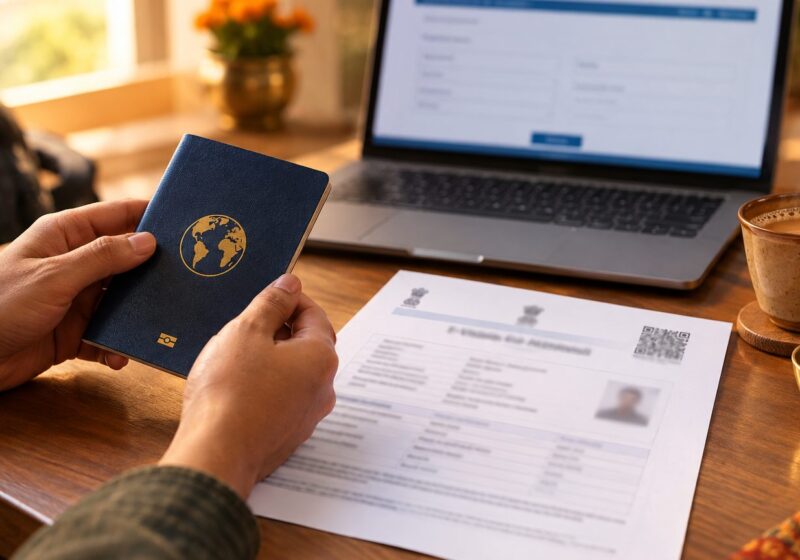
Yes. A foreign visitor can drive in India on a valid home driving licence together with an International Driving Permit, generally for up to a year. After that, or if you become a resident, you need an Indian licence.
India is a party to the 1949 Geneva Convention on Road Traffic, as are the United States, the United Kingdom and most of Europe. The IDP issued under that convention is the one India recognises, and it stays valid for one year from its date of issue (see the Geneva Convention on Road Traffic).
What’s legal and what’s sensible are different questions, though. Driving yourself in India is permitted; whether it suits your trip depends on your experience and your route.
The paperwork for driving yourself in India is simple. The common mistake is is leaving the IDP until they’re already in India, because it can only be issued in the country that issued your licence.
| Document | What it is | Notes |
|---|---|---|
| Home driving licence | Your full, valid licence | Carry the original; photocopies aren’t accepted at a checkpoint |
| International Driving Permit | 1949 Geneva Convention IDP | Get it at home before you travel; valid one year from issue |
| Passport and Indian visa | Proof of identity and legal stay | Rental companies and police may ask for both |
| Vehicle papers | Registration, insurance, pollution certificate | Must be in the car; the rental company supplies them |
| Credit card | For the rental deposit | Some Indian booking sites don’t take foreign cards |
In the United States the IDP comes through AAA; in most other countries it’s issued by the national motoring organisation or post office. It’s cheap and quick, but leave a few weeks to be safe.
The International Driving Permit India asks for is a translation of your licence, not a licence in itself. Always carry both together.
Self drive car rental India is a real, growing market, but it’s built mainly for Indian customers with Indian documents and Indian payment cards. Foreign visitors can rent, with some effort.

| Company type | What they ask foreign drivers for | What to watch |
|---|---|---|
| App-based rentals (Zoomcar, Revv and others) | Passport, visa, home licence, IDP, credit card; minimum age usually 21, sometimes 25 for bigger cars | Online checkout may reject foreign cards; confirm by email first |
| Local rental agencies in tourist areas | Passport and licence, often a cash deposit | Check insurance papers and the car’s condition carefully |
| International brands | Limited self-drive presence in India | Many offer chauffeur-driven cars rather than self-drive |
Revv’s own guide for international travellers lists a passport and visa, the original home licence, an IDP and a credit card for the deposit, with drivers usually aged 21 or over and 25 or over for some categories. Zoomcar also asks for an IDP, home licence and passport. Travellers regularly report that foreign cards fail at online checkout, so confirm the payment method before you land.
Before driving yourself in India in a rental, look at the number plate. Legitimate self-drive rental cars carry a black plate with yellow letters. A private car has black letters on white, and a taxi has black letters on yellow. A white-plate private car rented to you informally isn’t insured for that use.
Third-party insurance is compulsory for every vehicle in India, and a proper rental car will have it. What varies is the damage cover for the car itself and the excess you pay if something goes wrong.
One thing not to do: hire a car with a driver and then ask to take the wheel yourself. Tourist taxis are commercially registered and insured for their licensed driver. We don’t allow it, and no responsible operator should.
The Ministry of Road Transport and Highways publishes an annual report on road accidents. The latest edition, for 2024, was released on 12 June 2026. The figures are sobering, and they’re the best answer to the question is it safe to drive in India.
| Measure (2024) | Figure |
|---|---|
| Road accidents | 4,87,707 (up about 1.5% on 2023) |
| Deaths | 1,77,175 |
| Injuries | 4,71,441 |
| Deaths per hour | About 20 |
| Share of deaths on national highways | 36.6% (national highways carry 31% of accidents) |
| Two-wheeler riders among those killed | 46.2% |
| Pedestrians among those killed | 20.6% |
| Car, taxi and van occupants among those killed | 12.4% |
| Deaths in rural areas | About 71% |
Over-speeding is linked to roughly 70% of accidents and deaths. The year before, the ministry’s Road Accidents in India 2023 report counted 1,72,890 deaths, so the trend is still upwards.
Two things stand out for visitors. First, highways are where the danger concentrates, and highways are exactly where a tourist spends most of the trip. Second, the risk falls hardest on people outside cars: motorcyclists and pedestrians. Driving yourself in India means you’re responsible for not hitting them, at night, on roads you don’t know.
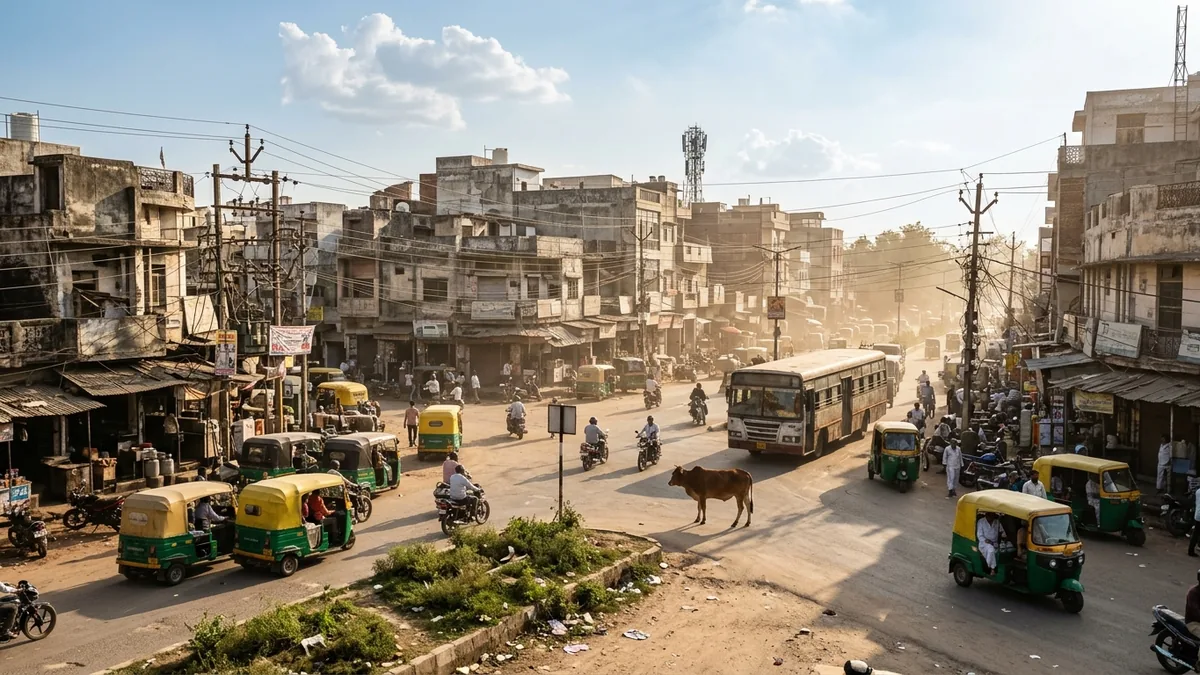
The rules of the road India has on paper are much like anywhere else. The way traffic actually flows is different, and it’s the unwritten code that catches visitors out.
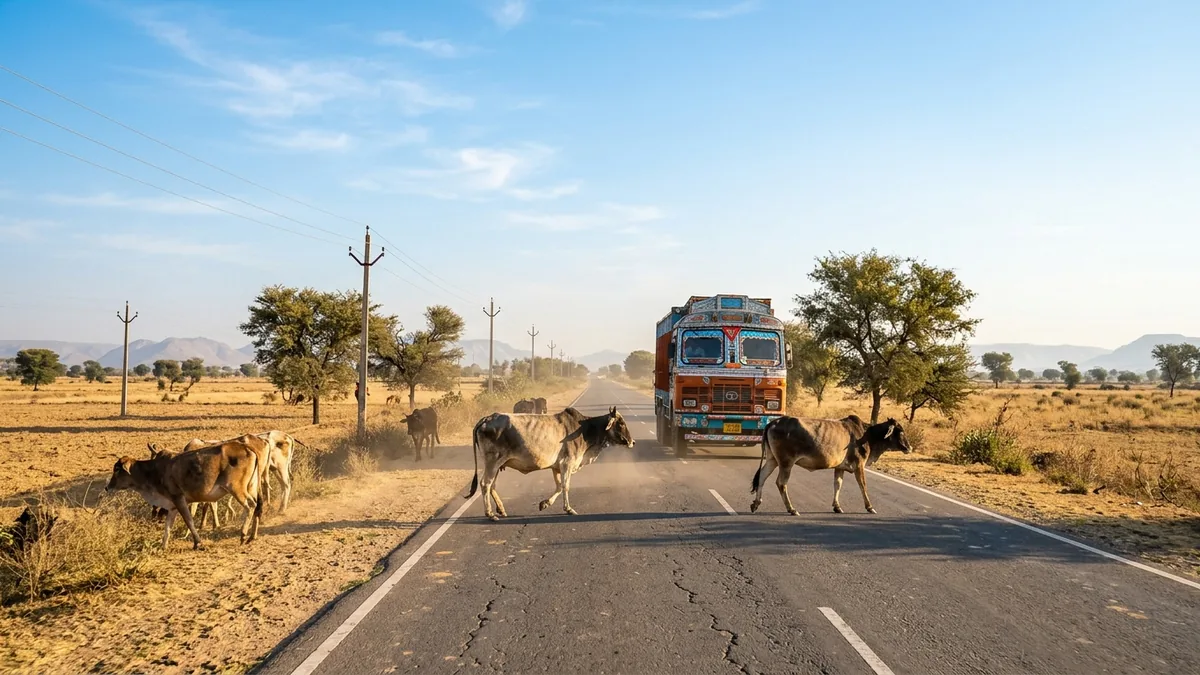
None of this is chaos. There is a logic to it, but it takes weeks, not hours, to learn, and a holiday isn’t long enough.
The Motor Vehicles Act was amended in 2019 and fines went up sharply. States can set their own amounts, and many use cameras. If you’re driving yourself in India, assume the rules are enforced.
| Rule | Detail |
|---|---|
| Side of the road | Drive on the left; cars are right-hand drive |
| Maximum speed for cars | Up to 120 km/h on expressways, 100 km/h on four-lane divided highways, 70 km/h in towns (lower where signed) |
| Drink-driving limit | 30 mg of alcohol per 100 ml of blood; first offence up to 6 months in jail and/or ₹10,000 |
| Speeding (car) | From ₹1,000 |
| Hand-held phone or dangerous driving | Up to ₹5,000 and possible jail |
| No seat belt | ₹1,000 |
| Driving without a valid licence | ₹5,000 |
| Not giving way to an ambulance or fire engine | ₹10,000 |
The drink-driving limit is set by Section 185 of the Motor Vehicles Act (full text on Indian Kanoon). It’s stricter than the UK’s and many US states’ limits. The simple rule is not to drink at all if you’re driving.
Seat belts are required for front and rear passengers. Helmets are compulsory on motorbikes and scooters for rider and pillion, and fines go with a possible three-month licence suspension.
The horn in India is a communication tool, not an insult. A short toot means “I’m here” or “I’m about to pass”. It’s why so many trucks have Horn OK Please painted on the back.
When you’re driving yourself in India, the hardest part isn’t learning the signals. It’s processing all of them at once, on the left, in a car you don’t know.
If you remember one piece of advice about driving yourself in India, make it this: don’t drive after dark outside city centres.
Our own drivers plan their days to finish before dark on highways wherever possible, and in fog season they wait rather than push on. That judgement is a large part of what you’re paying for when you hire a driver.
Tolls are part of driving yourself in India on almost any highway, and they’re collected electronically.
The rules are summarised on the FASTag page. On our tours, tolls, parking and state taxes are all included in the price, so none of this is your problem.
India has built new expressways at remarkable speed. Some routes that used to take a full day now take half that, and the road surfaces on the new expressways are excellent.
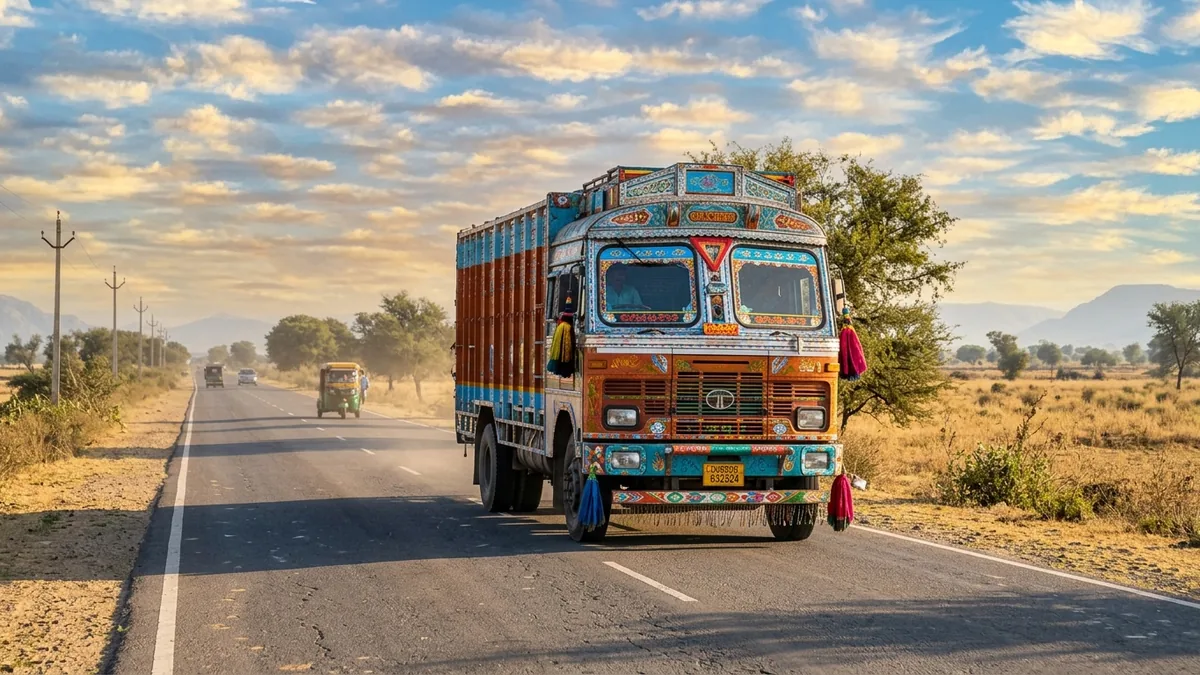
The Yamuna Expressway from Greater Noida to Agra is fast and divided. Between Delhi and Jaipur you can now take the Delhi–Mumbai Expressway as far as Dausa, as an alternative to the old NH48. Read our Delhi to Jaipur by car guide for the details of that route.
The catch is that expressways are only part of the journey. Getting to them, getting off them and getting across a town to your hotel all happen on older, busier roads. Two-lane highways, where most of Rajasthan’s driving happens, mean overtaking trucks that are heavily loaded and often slow.
Expressways have their own risks: high speeds, plus pedestrians, animals and wrong-way motorbikes. Driving yourself in India on an expressway is easier than on a village road, but it isn’t a European motorway.
The practical side is manageable if you prepare.
| Topic | What to know |
|---|---|
| Navigation | Google Maps works well on highways; in old cities it happily sends cars down lanes too narrow to turn round in |
| Mobile data | Buy a local SIM or eSIM on arrival; you’ll need an Indian number for many apps |
| Fuel | Petrol cost about ₹102 a litre in Delhi in September 2026; stations are attended, so you don’t pump it yourself |
| Paying for fuel | Cash or card; foreign cards sometimes fail, so carry rupees |
| Parking | Paid parking at monuments, ₹50–200; in old towns there may be none near your hotel |
| Sealed city centres | Some hill towns, such as Shimla, close their centres to cars |
| Breakdowns | Call the rental company first; the national highway helpline is 1033 |
Old city centres are where self-drive becomes hardest. Jaipur’s walled city, Jodhpur’s blue lanes and Varanasi’s old town are almost impossible to navigate by car if you don’t know them, and hotels there often have no parking. In Shimla, the centre is sealed and unauthorised driving brings heavy fines.
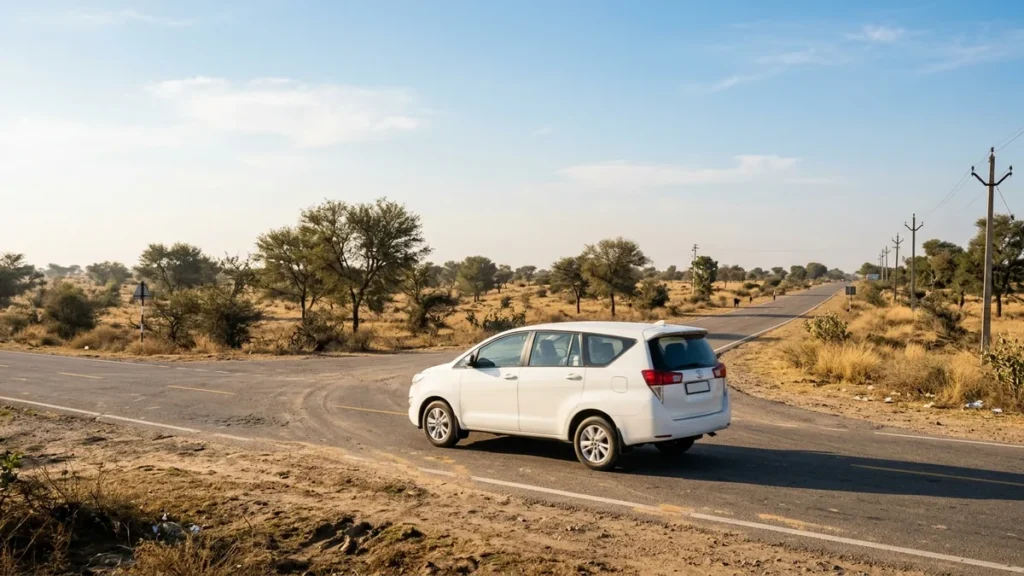
Many travellers assume driving yourself in India is the cheaper option. It usually isn’t, because drivers’ wages are low relative to fuel and rental costs, and the driver brings the car to you with everything already paid.
| Cost for a 4-day Golden Triangle (about 750 km) | Driving yourself | Car with our driver |
|---|---|---|
| Car rental | Daily rental rate (quote varies by city and season) | Included |
| Fuel | About 50–60 litres, roughly ₹5,000–6,500 | Included |
| Tolls | Several expressway and highway tolls | Included |
| Parking | ₹50–200 per stop, several times a day | Included |
| State taxes and permits | Depends on the rental permit | Included |
| Deposit and insurance excess | Refundable deposit; excess if damaged | None |
| Driver’s food and lodging | Not applicable | Included |
| Your time and attention | All of it, on the road | Free to look out of the window |
| Total | Rental + about ₹8,000–10,000 in running costs, plus risk | USD 356 for the whole car (sedan) |
At about ₹95 to the US dollar, USD 356 is roughly ₹34,000 for four days, with nothing more to pay for the car. Once you add a rental fee, fuel, tolls and parking to self-drive, the gap is small, and it runs in the driver’s favour once you count the deposit, the insurance excess and the stress.
For a fuller picture of market rates, see how much a car and driver costs in India. If you do hire a driver, our tipping guide explains what’s fair at the end.
We don’t want to pretend self-drive is never right. It can work well in some situations:
It usually doesn’t work well for a first visit on a tight itinerary like the Golden Triangle, where days are long, cities are congested and the whole point is seeing Delhi, Agra and Jaipur rather than their traffic.
There’s also a middle way: a driver for the long highway days and the old cities, and your own feet or a bicycle once you arrive. For how drivers and licensed guides divide the work, read guide or driver in India.
If you decide against driving yourself in India, these are our whole-vehicle prices for the most popular routes. They cover the car, the driver, fuel, tolls, parking and state taxes, and the driver’s own food and lodging. Hotels, meals, entry tickets and guides are extra.
| Tour | Sedan (1–3) | SUV (4–5) | Tempo Traveller (6–8) |
|---|---|---|---|
| Same-Day Taj Mahal Tour from Delhi | USD 113 | USD 154 | USD 202 |
| Delhi Sightseeing by Car, 2 days | USD 178 | USD 244 | USD 320 |
| Golden Triangle Tour, 4 days | USD 356 | USD 488 | USD 640 |
| Golden Triangle Tour, 6 days | USD 534 | USD 732 | USD 960 |
| Jaipur Jodhpur Udaipur Tour, 8 days | USD 712 | USD 976 | USD 1,280 |
| Shimla Manali Tour, 8 days | USD 800 | USD 1,096 | USD 1,440 |
Every trip is private and tailor-made, with no booking fee. See all our car and driver rates in India, or ask us to build a tailor-made India tour around your dates.
Tell us your dates, group size and the places you want to see. We reply within 24 hours with a fixed price for the car and driver. If you’d like a detailed day-by-day itinerary, it costs €100, and the full €100 is deducted from your tour price when you book. There is no obligation.
Tailor-Made India & Nepal
Tell us what you love and we reply within 24 hours with a fixed price. A detailed day-by-day itinerary costs €100, deducted in full from your tour price.
Pick one or more destinations — you can mix India and Nepal freely.
This helps us match the right pace, stay and activities.
We reply within 24 hours. No spam, ever.
Before driving yourself in India, answer these eight questions:
If you can answer yes to all of these, you’re better prepared than most. If not, a driver is the safer and often cheaper choice.
Think of it as three questions.
Can I? Yes, with your licence and an IDP, for up to a year. Should I? Only if you have real experience of traffic like India’s and a route that keeps you off the roads at night. Is it cheaper? Rarely, once fuel, tolls, parking, deposits and risk are counted.
For most first-time visitors, the best way of driving yourself in India is to sit in the front seat next to someone who does it every day, and ask him everything.
Yes. Driving yourself in India is legal with a valid home licence and an International Driving Permit, generally for up to one year. After that, or once you’re resident, you need an Indian licence.
Yes. For driving yourself in India you need the IDP issued under the 1949 Geneva Convention, which is valid for one year from issue. You must get it in the country that issued your licence, before you travel, and carry it with your original licence.
The left. Cars are right-hand drive, like in the UK, Australia and Japan. Visitors from right-hand traffic countries find this adds a lot to the challenge of driving yourself in India.
It’s riskier than in most Western countries. India recorded 1,77,175 road deaths in 2024, about 20 an hour, according to the Ministry of Road Transport and Highways. National highways account for 36.6% of deaths, and night driving is especially dangerous.
Yes, with effort. App-based companies such as Revv and Zoomcar ask for a passport, visa, home licence, IDP and a credit card, and a minimum age of 21 or 25. Foreign cards sometimes fail at online checkout, so confirm by email first.
Black with yellow letters. Private cars have black letters on white, and taxis black on yellow. Don’t rent a white-plate private car informally for driving yourself in India, because it won’t be insured for rental use.
30 mg of alcohol per 100 ml of blood. A first offence can bring up to six months in jail, a ₹10,000 fine, or both. The safest rule is not to drink at all if you’re driving.
For cars, up to 120 km/h on expressways, 100 km/h on four-lane divided highways and 70 km/h in towns, with lower limits wherever they’re signed. States and cities often set lower limits and use cameras.
Yes, on national highways. Without a valid FASTag you pay double the toll in cash, or 1.25 times the rate by UPI since November 2025. A rental car should already have one fitted, so check it has credit.
A car with a driver is usually similar or cheaper. Our 4-day Golden Triangle costs USD 356 for a sedan with fuel, tolls, parking and taxes included, while driving yourself in India adds rental, around ₹8,000–10,000 in running costs, a deposit and an insurance excess.
No. Tourist taxis are commercially registered and insured for their licensed driver. Responsible operators, including us, don’t allow guests to take the wheel.
We advise against it outside city centres. Unlit tractors, parked trucks, full-beam headlights and animals make night driving the most dangerous part of driving yourself in India.
Two-wheeler riders made up 46.2% of road deaths in 2024. If you ride, wear a proper helmet, which is compulsory for rider and pillion, and avoid busy cities and highways.
If you have an accident while driving yourself in India, call 112 if anyone is hurt, then your rental company. Stay calm, take photos and don’t sign anything you can’t read. Crowds gather quickly, so let the police or the company handle it.
Yes. It uses the Ministry of Road Transport and Highways figures for 2024, released in June 2026, and the toll rules in force in 2026. Fines and rental rules change, so check before you travel.
India is one of the great road-trip countries. The question is only who should be behind the wheel.
If you’re experienced, prepared and patient, self-drive is possible. Get your IDP at home, rent from a proper company, never drive at night, and give yourself far more time than the map suggests.
If you’d rather spend the trip looking at forts, temples and villages, let a local driver handle the road. It costs about the same, and you’ll arrive rested.
Either way, we hope this guide to driving yourself in India helps you choose. For more planning, read our car and driver cost guide, Delhi to Jaipur by car and how many days you need for the Golden Triangle.
See the 4-day Golden Triangle tour · Car and driver rates in India · Plan my trip