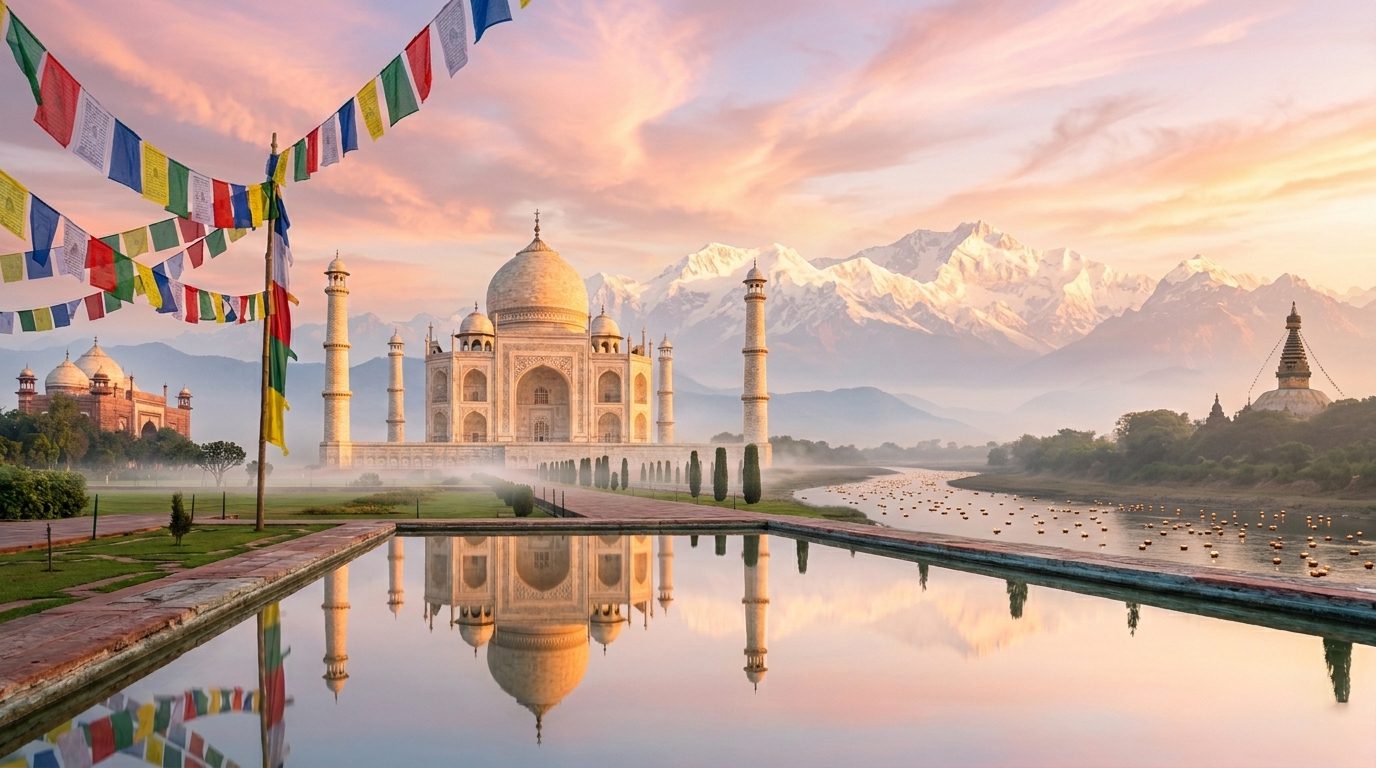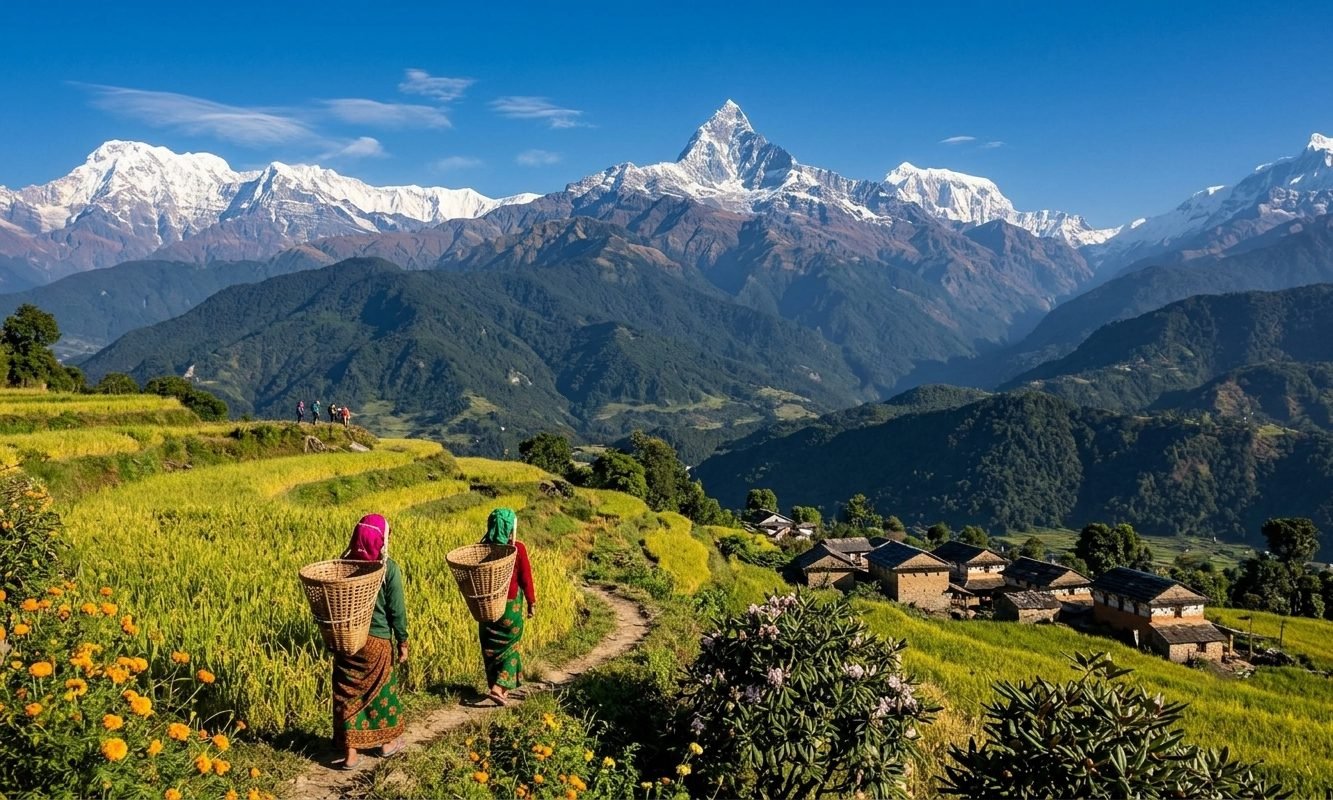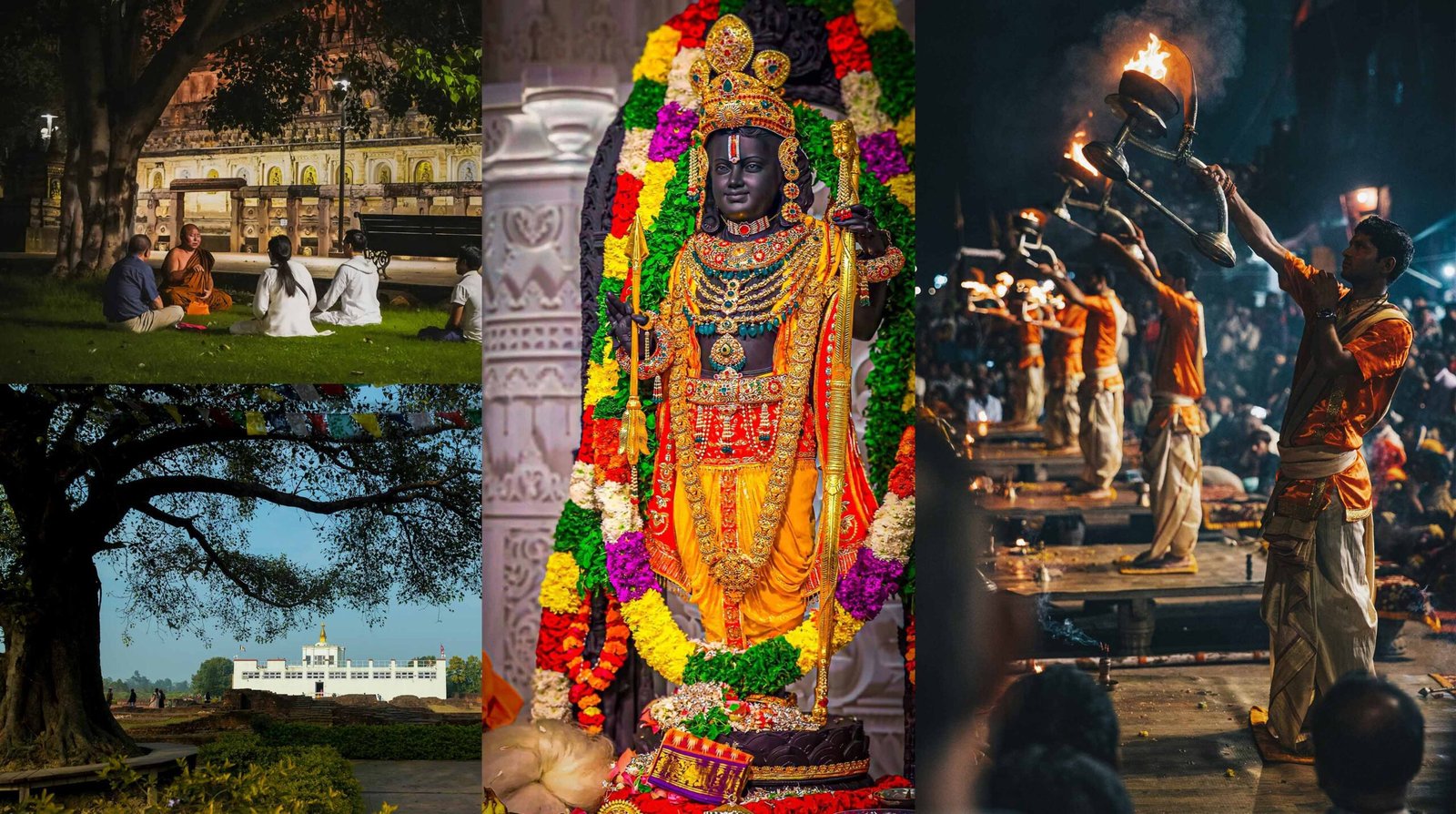
Most people plan India and Nepal as two separate holidays. They do not have to be. The two countries share a long open border, the overland crossings are straightforward, and a single trip that takes in the Taj Mahal and the Himalaya is one of the most rewarding journeys in Asia.
We have been arranging this route from Delhi and Kathmandu for close to thirty years. This guide covers how the trip actually works: the routes that make geographic sense, how long you need, when to go, and what a private tour of both countries involves.
The two countries sit side by side, but they feel nothing alike. India gives you Mughal architecture, painted Rajasthani cities and the crowded, alive banks of the Ganges. Nepal gives you thin mountain air, Newar courtyards and a pace that slows the moment you leave Kathmandu.
Travelling between them takes hours, not a long-haul flight. Kathmandu to Delhi is roughly a ninety-minute flight. Overland, the Sunauli and Kakarbhitta crossings connect northern India to Nepal by road. Either way, you are moving between two entirely different worlds without crossing an ocean.
Fourteen days is the realistic minimum if you want to see both countries without spending the whole trip in transit. Here is how the time tends to divide:
Our India-Nepal Grand Odyssey runs the longer version, from the Taj Mahal through to the Buddha birthplace at Lumbini.
Geography should decide the order, not a brochure. The most efficient shape is a single arc rather than a loop that doubles back.
Delhi is the usual entry point. From there the Golden Triangle runs Delhi to Agra to Jaipur, and back to Delhi. Add Varanasi if the Ganges matters to you, and it is a short flight onward to Kathmandu.
Fly Delhi or Varanasi to Kathmandu, or cross overland at Sunauli if you want to include Lumbini on the way through. The overland option adds a day but gives you the border country, which most travellers never see.
Kathmandu for the valley towns, Pokhara for the lake and the Annapurna skyline, Chitwan for the lowland jungle. Three stops, roughly seven to nine days.
The two countries share a monsoon, which simplifies the decision.
India and Nepal require separate visas for most nationalities. India is normally an e-Visa applied for before travel. Nepal issues visas on arrival at Kathmandu airport and at the land borders for most passports. If you plan to re-enter India after Nepal, make sure your Indian visa allows multiple entries. This catches people out more than anything else on this route.
We want to be straightforward about this, because it is where a lot of operators are vague.
On our road tours in India and Nepal, the price covers your private vehicle, your driver, fuel, tolls, state taxes, place permits and the driver own food and accommodation. You get a car and a driver who knows the roads, for every kilometre of the trip.
It does not include hotels, your meals, monument entrance fees, guides, visas or flights. That is a deliberate choice. It keeps the price honest and lets you pick your own hotels at your own budget rather than paying our markup on a room you did not choose.
If you would rather we handled all of it, we can. Hotels, city guides, monument tickets, domestic flights, all of it can be arranged at additional cost. Just tell us what you want and we will quote it.
Our trekking trips work differently. On a trek the price includes accommodation, all meals, your guide and the permits, because a trek without those is not a product anyone can use.
Yes. The countries share an open border and are connected by short flights and road crossings. Fourteen days is enough to see the highlights of both.
Yes. Most nationalities need an Indian e-Visa arranged in advance and can get a Nepali visa on arrival. If you return to India after Nepal, you need a multiple-entry Indian visa.
October and November. The monsoon has cleared, the Himalayan views are sharp and northern India is pleasant rather than punishing.
Flying is faster and simpler. Going overland via Sunauli lets you include Lumbini and see the border country, at the cost of an extra day.
Every trip we run is private and built around the people travelling. If you tell us roughly how long you have and what you care about, we will put a route together. Have a look at our India and Nepal tours, or send us your dates and we will come back with a plan.